stock here: LOL this is a tough field to “break in to”.
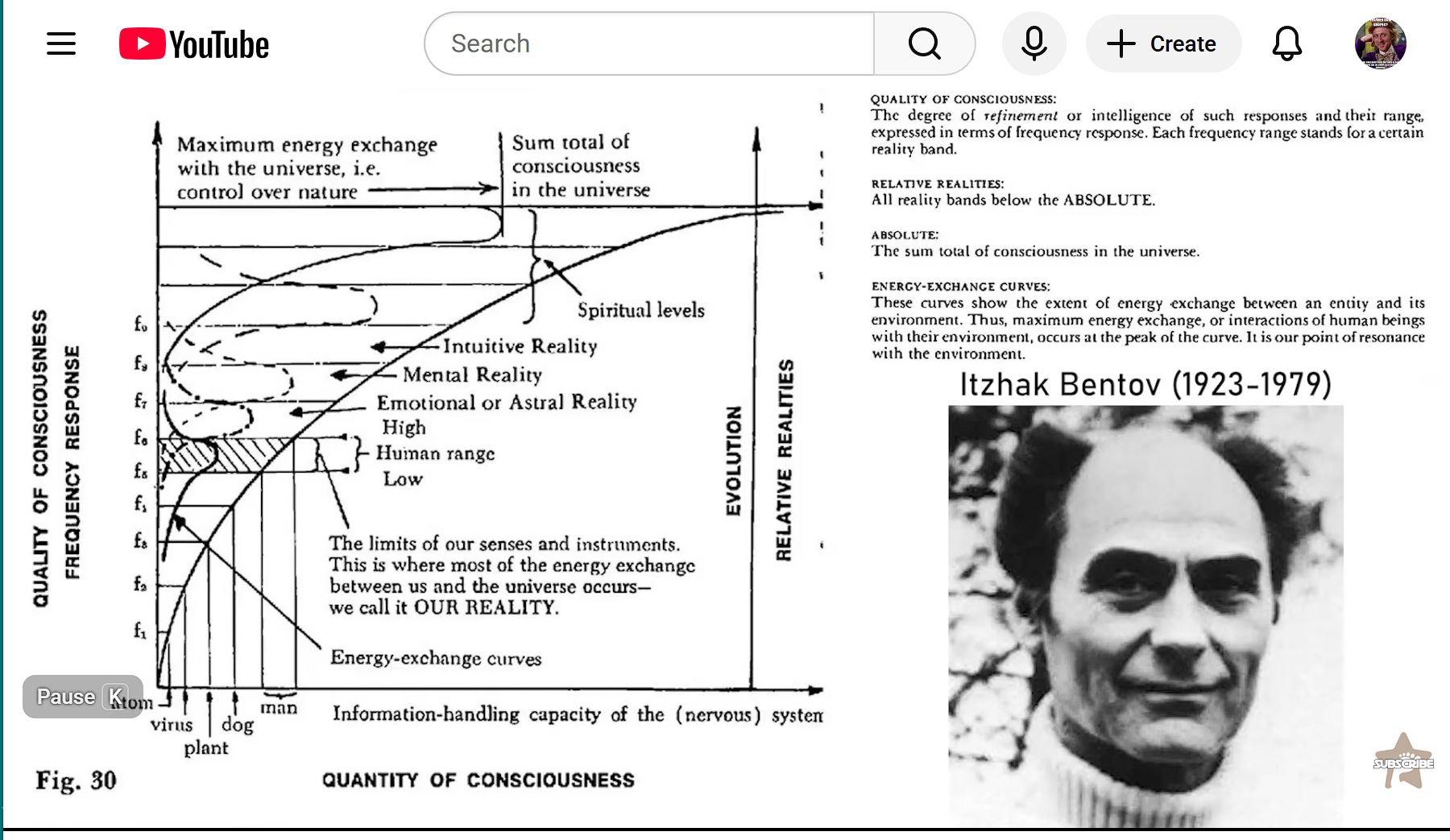
I saw this on the recent Stefan Burns production. I love this chart.
————————–
Reactions to Bentov’s ideas have always been mixed:
- Psychologists like Christina and Stanislav Grof found his work inspiring, folding it into broader theories of non-ordinary states.
- Integral thinkers like Ken Wilber wove his holographic vision into models of consciousness.
- Neuroscientists, however, mostly shook their heads. There’s no empirical proof that aortic standing waves launch the soul into orbit.
Still, Bentov was ahead of his time in noticing that physiology and consciousness are deeply intertwined.
Today’s research on brain–heart coherence, vagal tone, and meditation echoes what he hinted at decades earlier. Bentov went there first.
The Strange End of a Life About Strange Things
In 1979, Bentov was aboard the infamous American Airlines Flight 191 when it crashed moments after takeoff from Chicago O’Hare. It was the deadliest aviation accident in U.S. history at the time. He was just 55.
For a man who spent his career sketching diagrams of consciousness leaving the body, the irony was hard to miss. Friends said he had always believed death was less of an ending and more of a transition. I imagine he would not have been surprised.
Why Bentov Still Matters
Bentov’s theories still remain more poetry than proof. But I’ve noticed that poetry has a way of shaping how we think.
Therapists today often borrow his metaphors unwittingly, describing resonance in relationships, the tuning of nervous systems, and the way human beings feel part of something larger.
The intriguing bottom line is this: Bentov offered a vision of consciousness not as a private possession but as a shared field, one we’re all plugged into, whether we know it or not.
He offered a vision of consciousness not as a possession locked inside the brain but as a shared field of awareness, one we’re all immersed in whether we notice it or not. That simple, radical idea — that we are not isolated minds but participants in a larger pattern — may be why his work still hums like a struck tuning fork, decades after his voice was silenced.
That hum also continues to attract dreamers, seekers, and the occasional intelligence officer.
Be Well, Stay Kind, and Godspeed
REFERENCES:
Bentov, I. (1977). Stalking the wild pendulum: On the mechanics of consciousness. New York: Dutton.
Grof, S. (1985). Beyond the brain: Birth, death, and transcendence in psychotherapy. Albany: State University of New York Press.
McDonnell, W. B. (1983). Analysis and assessment of the Gateway process. U.S. Army Operational Group. Declassified 2003.
Wilber, K. (2000). Integral psychology: Consciousness, spirit, psychology, therapy. Boston: Shambhala.