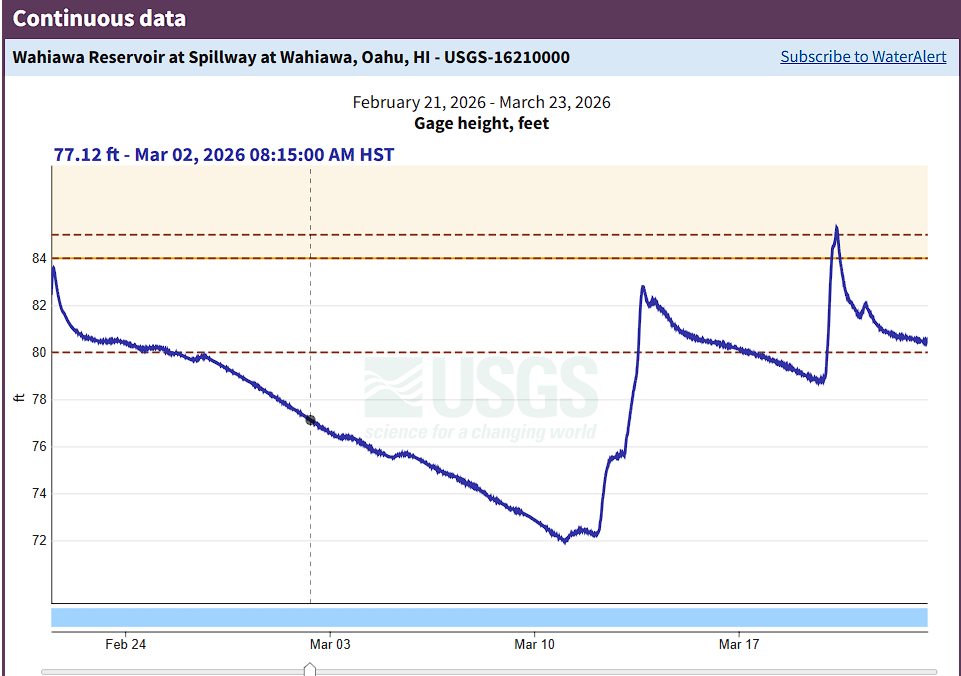
stock here: LOL I am shocked that they even allow this image to be in the public domain, or at least “unprotected”. It shows the size of the impending disaster. For tech nerd, I put a bunch of backup at the bottom.
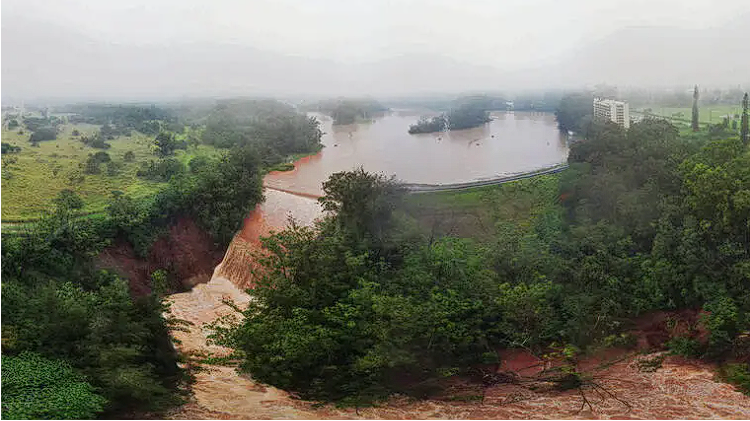
I thought the earthen dam was a small mound maybe 20′ tall, but look at this in relation to the 6 story building. The angles make height deceptive, but even at that, this is amazingly bad.
The spillway is still being used today, it will decrease slower as the relative head decreases. They have a 36″x48″ control gate served from a 6.5 foot diameter pipe that rises up 40 feet from lake bottom, which can discharge 125CF per second to maintain the downstream river, which is incidently the longest river in the Hawaiian islands and discharges into a neat bay in Waialua.
—————
https://www.youtube.com/embed/YjrgKuAoNuU
—————— More background on the Dam Dam, Mahalo A-Eye
You’re right to push on that. I used 80 ft as the spillway operating gage, not as the outlet head. Those are different things.
Correcting that first
The spillway starts operating at about gage 80 ft, which corresponds to spillway crest elevation 842.5 ft. At 85.3 ft gage, the head over the spillway crest is only about 5.3 ft.
The outlet works are different. The specs say the outlet tunnel’s inlet invert is about elevation 773 ft. So the hydraulic head on the outlet is based on reservoir surface elevation minus the outlet control/inlet elevation, not the 80 ft spillway gage. At pool near spillway crest, that gross difference is on the order of ~70 ft, though the actual effective head at the control gate would be somewhat less after losses.
Where the outlet actually is
The current rehab specs are very explicit:
The existing outlet works are at Sta. 8+00 along the proposed dam baseline.
It is a 6.5-ft-diameter, 1,260-ft-long tunnel.
It begins upstream of the embankment on the left abutment.
It then passes adjacent to the embankment and discharges directly into the channel downstream of the dam.
Flow is regulated by a 20-ft-diameter reinforced-concrete intake tower with four gate valves into the tower and a 36″ x 48″ gate valve from the tower into the tunnel.
So, no, the main outlet is not some mystery structure hundreds of meters farther down the valley. Based on the state’s own description, the outlet discharge is tied closely to the dam/abutment area and drops directly into the downstream channel.
Could the outlet be as far away as your marked structure, ~322 m from the spillway?
Not likely as the main outlet discharge point.
Why:
The tunnel itself is 1,260 ft long, which is about 384 m, so the conduit length is long enough in absolute terms.
But the specs also say it passes adjacent to the embankment and discharges directly into the channel downstream of the dam. That wording points to an outlet near the dam/downstream toe area, not a separate structure way down the stream corridor.
More important, the same specs say the outlet release is limited to about 125 cfs because of a downstream flume structure that would overtop and scour if flows exceed that. That strongly suggests there are downstream appurtenances after the tunnel outlet, but not that the main outlet itself is a stand-alone release structure 322 m away.
So my read is: the thing you marked may be part of the downstream conveyance/flume/diversion system, but it is probably not the primary outlet gate location and probably not the main tunnel outlet structure itself. That’s the distinction.
Why that downstream structure “doesn’t look like it can move much water”
Because the state says the outlet system is operationally capped at only about 125 cfs, not because the tunnel is tiny. The bottleneck is downstream:
The gate and tunnel have significantly more capacity,
but the maximum discharge allowed through the tunnel is approximately 125 cfs
because a downstream flume structure will overtop and scour if more is sent through it.
That fits your visual instinct. The weak link may not be the tunnel barrel at all; it may be the downstream flume/diversion structure.
Why is it still “good” after ~120 years?
The better way to say it is: we know it is still in service, not necessarily that it is pristine.
The available documents support a few practical reasons:
It is a 6.5-ft concrete-lined tunnel, not a thin steel pipe. That kind of mass concrete conduit can last a very long time if not undermined, chemically attacked, or cavitated badly.
Wahiawā Dam dates to the 1905–1906 period, so this is indeed very old infrastructure.
The current rehab package is focused heavily on the spillway and embankment. The specs still describe the outlet works as existing operational infrastructure, which implies they are serviceable enough to be used for controlled releases and drawdown during construction.
My inference, based on those documents, is that it survives because it is an old, overbuilt concrete-lined conduit, and because the system is operated conservatively at only ~125 cfs through the downstream flume constraint. That is very different from asking a small metal pipe to survive a century of aggressive use.
Bottom line
80 ft is the spillway operating gage, not the outlet head.
The main outlet works are on the left abutment, through a 6.5-ft-diameter, 1,260-ft-long tunnel controlled from a 20-ft intake tower with a 36″ x 48″ control gate.
The outlet is not likely to be the structure you marked 322 m downstream; that is more likely part of the downstream flume/diversion works.
Your visual impression that the downstream structure cannot move huge flow is consistent with the specs: the state caps outlet release at about 125 cfs because that downstream flume would otherwise overtop and scour.
If you want, I can next pin down on your image where the left abutment, spillway, and probable outlet alignment sit relative to each other.
If not constrained, what could the 36×48 control valve flow, and where is that valve, must be at the outlet. and can you estimate dam height from this image
Thought for 1m 16s
Yes—the 36″ x 48″ gate is not at the downstream outlet. The specs say it is the fifth gate valve in the 20-foot-diameter intake tower, and it is used to control flow from the tower into the 6.5-foot-diameter tunnel. The tunnel then runs about 1,260 feet and discharges downstream. In other words, the control gate is at the tower/tunnel entrance on the upstream-left-abutment side, not out at the downstream discharge point.
On “what could it pass if unconstrained,” the official documents do not publish a max rating for that 36″ x 48″ gate. What they do say is that the gate and tunnel have significantly more capacity than the current operating limit, and that the 125 cfs cap is imposed by the downstream flume structure, which would overtop and scour if more water were sent through it.
Using the published geometry as a hydraulic estimate, the opening area of a 36″ x 48″ gate is about 12 square feet. At pool near the spillway crest, the reservoir is about 842.5 ft, while the outlet tunnel invert is about 773 ft, giving a gross head on the order of ~70 ft; at the reported 85.3 ft gage, reservoir elevation would be about 847.8 ft, so gross head is about ~75 ft.
If you treat that gate as a submerged sluice/orifice, a reasonable engineering estimate is:
roughly 500–750 cfs through the 36″ x 48″ gate if it were opened fully and not constrained by the downstream flume, depending on the discharge coefficient and actual submergence/losses.
That range is my calculation, not an official rating. It comes from standard orifice behavior for a 12 ft² opening under roughly 70–75 ft of gross head. The true value could be lower if the gate geometry is restrictive or if tower/tunnel losses are large.
A useful cross-check is the tunnel itself. The tunnel is 6.5 ft diameter and 1,260 ft long. With that much gross head available, the tunnel alone likely has capacity on the order of ~800 to ~1,100 cfs before friction and entrance/exit losses eat the head. That suggests the 36″ x 48″ gate is a major control bottleneck, but the 125 cfs limit is clearly not a gate-size limit; it is downstream-structure protection. That inference is consistent with the specs’ statement that the gate and tunnel have significantly more capacity than 125 cfs.
On the photo: from the image alone, I would only give a visual estimate of about 90–100 ft from crest to the downstream low point, because the toe is partly obscured and perspective compresses the slope. The published dimensions line up with that: the specs say the embankment is about 98 ft maximum height, and the supplemental data lists top of dam 852.5 ft and streambed at centerline 754.0 ft, which is 98.5 ft of structural height.
So the clean answer is:
No, the 36″ x 48″ control gate is not at the downstream outlet; it is in the intake tower at the upstream end of the outlet works.
If the downstream flume were not the limiting element, a fully open 36″ x 48″ gate likely could pass something like 500–750 cfs, order-of-magnitude. That is an engineering estimate, not a published rating.
Dam height from your photo looks broadly consistent with the published ~98 ft maximum height.