stock here: I find it odd to remove this “certified” priest exorcist, simply because he links some UFOs with Demons. Methinks he was getting too popular on Social Media.
Rossetti, who has over 148,000 followers on Instagram, is a prominent psychologist as well as an exorcist. His center has specialized in offering spiritual healing for priests troubled by various difficulties.
Indeed, priests with demons in them, are the worst.
—————- A “splain” it
To be recognized as an exorcist by the Archdiocese of Washington, or any Catholic diocese, a priest does not simply declare himself an exorcist. Under Catholic canon law, a priest must be specifically appointed by the local bishop.
The relevant law is Canon 1172 of the Catholic Church:
No one can legitimately perform exorcisms over the possessed unless he has obtained special and express permission from the local ordinary (bishop).
The typical requirements are:
- Ordained Catholic priest
- Good standing with his bishop
- Demonstrated theological and spiritual maturity
- Prudence, psychological balance, and discretion
- Specialized training (often through courses in Rome)
- Formal appointment by the diocesan bishop
The bishop can also revoke that appointment at any time.
In the case of the Archdiocese of Washington, Cardinal Robert McElroy has authority over who may publicly function as an exorcist within the archdiocese.
What happened with Fr. Rossetti?
The priest mentioned is Stephen Rossetti.
From public reporting, the Archdiocese of Washington clarified that Rossetti remains a priest in good standing but is no longer authorized to present himself publicly as an exorcist for the Archdiocese of Washington after comments suggesting that many UFO sightings may actually be demonic manifestations.
The key issue was not that he believed demons exist. The Catholic Church absolutely teaches the existence of demons and the possibility of demonic influence.
Rather, the concern appears to have been that:
- He publicly connected UFO phenomena with demonic activity as a personal opinion.
- He spoke in a way that could be interpreted as presenting that opinion with ecclesiastical authority.
- The Church has no official teaching that UFOs are demons.
The Vatican has generally taken a cautious position: claims of UFOs, extraterrestrials, apparitions, mystical experiences, and alleged supernatural events should be investigated carefully without jumping to conclusions.
Does the Catholic Church allow belief in aliens?
Yes.
Several high-ranking Catholic figures have explicitly said that belief in extraterrestrial life is not contrary to Catholic doctrine.
For example, Guy Consolmagno has repeatedly stated that the discovery of extraterrestrial life would not contradict the Catholic faith.
The Church has no dogma requiring belief or disbelief in extraterrestrials.
Why would an exorcist suspect UFOs are demonic?
Many exorcists approach the issue from a spiritual-warfare perspective.
Their reasoning is often:
- Some UFO encounters involve messages hostile to religion.
- Some alleged alien-abduction reports contain elements similar to historical demonic oppression cases.
- Certain experiencers report relief through prayer or religious practices.
Because of those parallels, some exorcists suspect that at least some phenomena could be spiritual rather than extraterrestrial.
However, that remains a theological opinion, not official Church teaching.
Historically, has the Church ever taught that UFOs are demons?
No.
The Church has historically taught:
- Angels exist.
- Demons exist.
- Spiritual beings can deceive humans.
- Extraordinary claims require discernment.
But there is no official Catholic doctrine stating:
“UFOs are demons.”
Nor is there doctrine stating:
“Aliens definitely exist.”
Both remain open questions.
An interesting distinction
Most Catholic theologians would separate three questions:
- Are there extraterrestrial intelligences somewhere in creation?
- Possibly.
- Are some alleged UFO experiences psychological, mistaken, fraudulent, or natural phenomena?
- Certainly possible.
- Could some experiences involve spiritual deception or demonic influence?
- Theologically possible according to Catholic teaching.
Where Fr. Rossetti’s comments became controversial was moving from #3 (“some could be”) toward “many or most are demons,” which goes beyond anything formally taught by the Church.
So, if your question is whether someone could become an exorcist in Washington while holding Rossetti’s views: yes, a priest could privately hold that opinion. But once acting under the authority of the archdiocese, he would generally be expected to distinguish clearly between official Catholic doctrine and his personal theological speculation.
Yes. People reported strange aerial phenomena long before the term “UFO” existed. However, they did not usually describe them as spacecraft. They interpreted them through the worldview of their era: angels, demons, divine signs, celestial armies, dragons, flying ships, or omens.
A few notable examples:
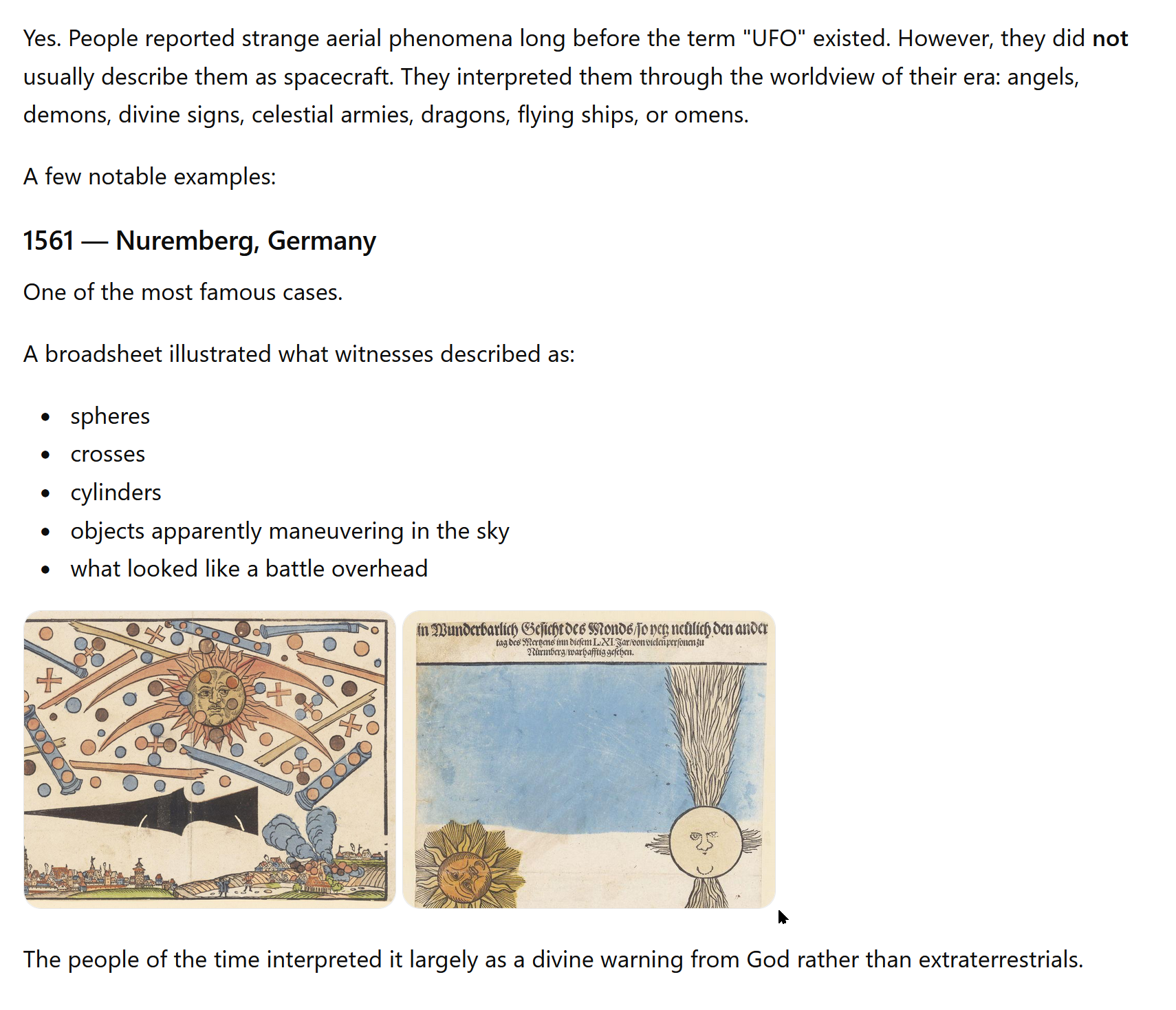
1561 — Nuremberg, Germany
One of the most famous cases.
A broadsheet illustrated what witnesses described as:
- spheres
- crosses
- cylinders
- objects apparently maneuvering in the sky
- what looked like a battle overhead


The people of the time interpreted it largely as a divine warning from God rather than extraterrestrials.
1566 — Basel, Switzerland
Reports described black spheres moving through the sky and apparently colliding with one another.
Again, contemporaries viewed this as a heavenly sign.
1639 — Colonial America
John Winthrop recorded an account in which several men allegedly observed a bright light moving rapidly over a river. According to the report, the light maneuvered in ways they found unusual.
Modern UFO researchers frequently cite this account.
1700s
The 1700s contain many reports of:
- mysterious lights
- “fiery globes”
- luminous objects
- unexplained atmospheric phenomena
But the reports are generally less detailed than later accounts because:
- there were fewer newspapers
- fewer scientifically trained observers
- little incentive to preserve such reports
Many events that today might be called UFO sightings were instead recorded as:
- comets
- portents
- angelic signs
- atmospheric wonders
1800s — The “Airship” Wave
This is where things get particularly interesting.
In 1896–1897, thousands of Americans reported seeing mysterious airships.
Witnesses described:
- cigar-shaped craft
- bright lights
- apparent propulsion systems
- human-like occupants


4
What’s fascinating is that these objects often resembled what people imagined advanced technology might look like in the late 19th century.
This observation is one reason some psychologists argue that reports are influenced by culture.
What would Rossetti say?
If you apply Fr. Rossetti’s reasoning, he might argue:
- In the Middle Ages, people reported angels, demons, and heavenly battles.
- In the industrial age, people reported mysterious airships.
- In the space age, people report extraterrestrial craft.
Therefore, he might suggest the underlying phenomenon is the same but interpreted through different cultural lenses.
That is not a proven conclusion—it is one interpretation.
A challenge to the “it’s all aliens” idea
One reason some theologians and historians are skeptical that every UFO report involves extraterrestrial spacecraft is that the descriptions seem to evolve with human expectations:
| Era | Common Description |
|---|---|
| Medieval | Angels, demons, fiery chariots |
| 1700s | Omens, heavenly lights |
| 1890s | Airships |
| 1940s–1950s | Flying saucers |
| Modern | Advanced craft, drones, interdimensional beings |
2 replies on “UFO’s and Demons”
oddly I just saw this …
Fear and Love: The Story of The Exorcist
https://www.youtube.com/watch?v=4HfkMn55d9A
A world changing movie, indeed, we all need to recognize that evil exists, it’s real, and it’s dangerous.