stock here: advancing my theory on Crapitalism, and poking back at the arsehole collectivist who consistently make thing worse.
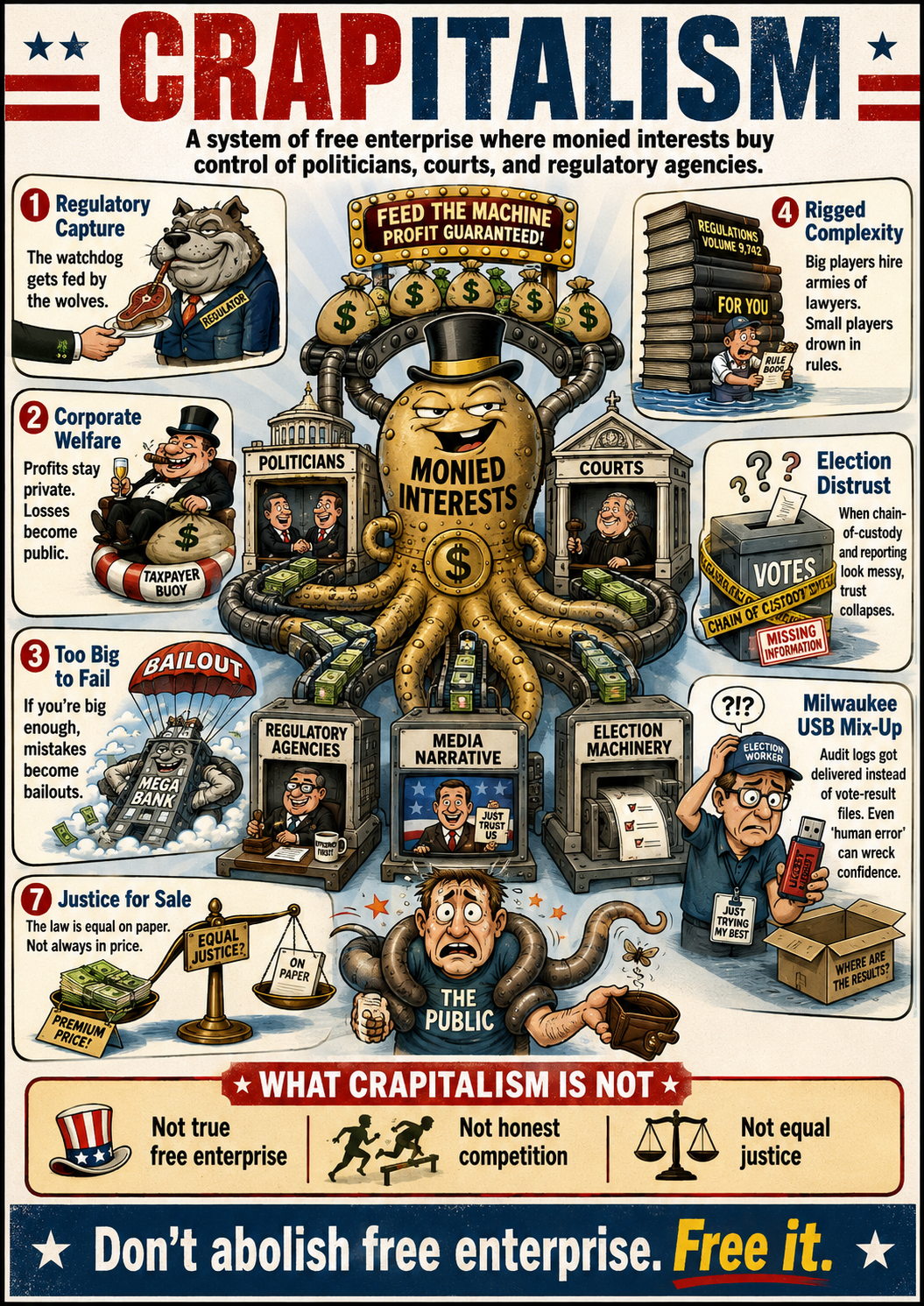
Crapitalism
A System of Free Enterprise Where the Monied Interests Buy Control of the Politicians, Courts and Regulatory Agencies
America was built on free enterprise: compete, innovate, work, take risks, own property, build something, and keep the rewards if you succeed.
But what we increasingly have isn’t free enterprise. It’s Crapitalism—a system in which competition still exists, but the rules can be bent, bought, manipulated, or selectively enforced by people and institutions with enough money and political influence.
THE MONEY–POLITICS LOOP
Politicians need enormous amounts of money to obtain and retain power. Wealthy interests need favorable laws, contracts, subsidies, tax provisions and regulations. Each side has something the other wants. Call it lobbying, access or influence—the incentive structure is obvious.
REGULATORY CAPTURE
Government agencies supposedly regulate industries. Then regulators leave government and work for those industries—or industry executives enter government and regulate their former competitors. Eventually the referee and the players start looking like members of the same team.
CORPORATE WELFARE
A genuine free market means businesses can succeed and fail. Crapitalism means politically connected companies can receive subsidies, bailouts, guarantees, special tax treatment and government contracts while ordinary businesses absorb their own losses. Privatize the profits; socialize the losses.
COMPETITION WITHOUT ENOUGH COMPETITION
When a handful of enormous corporations dominate banking, technology, communications, healthcare, insurance, agriculture or media, consumers may technically have “choices” while meaningful competition becomes increasingly difficult.
JUSTICE DEPENDS TOO MUCH ON MONEY
The law may be written equally, but navigating it isn’t equal. One citizen or small company can face an opponent capable of spending millions on lawyers, experts, discovery, appeals and years of litigation. A right you cannot afford to defend isn’t much of a right.
AN ELECTION SYSTEM THAT INVITES DISTRUST
The world’s most important democracy should have election records, voter rolls, ballot custody, counting procedures and audits that are simple, transparent, uniform and boringly reliable.
Instead, Milwaukee gave us a perfect example on August 11, 2026: five of nine USB drives delivered from Central Count contained audit logs rather than the vote-result files, delaying the reporting of thousands of absentee votes. Officials attributed it to human error, returned for the correct files, and said the underlying paper ballots and poll books remained intact.
That incident does not prove election fraud. It proves something more basic: procedures involving something as consequential as elections should be engineered so that this sort of mistake is extraordinarily difficult to make—and immediately detectable when it happens.
ACCOUNTABILITY FOR THE LITTLE GUY, SETTLEMENTS FOR THE BIG GUY
An ordinary citizen can have his life wrecked by a regulatory or legal mistake. Giant institutions can treat fines, settlements and compliance failures as another cost of doing business. That’s not equal justice or a healthy market.
GOVERNMENT WRITES TOO MANY RULES FOR PEOPLE WHO CAN AFFORD RULE-WRITERS
Complexity itself becomes a competitive advantage. Giant corporations can maintain armies of lawyers, accountants, lobbyists and compliance specialists. The small entrepreneur cannot. Sometimes the biggest companies don’t fear regulation—they help design it.
And then, after producing this mess, collectivists point at it and announce:
“See? Capitalism doesn’t work.”
Wrong.
This isn’t an argument for turning more economic power over to government. Government is already one of the things being captured.
The cure for Crapitalism is not collectivism.
It is more genuine competition, less corporate welfare, simpler laws, transparent government, auditable elections, equal justice, aggressive disclosure of conflicts of interest, and a very bright line between public service and private enrichment.