stock here: Gemini got game!
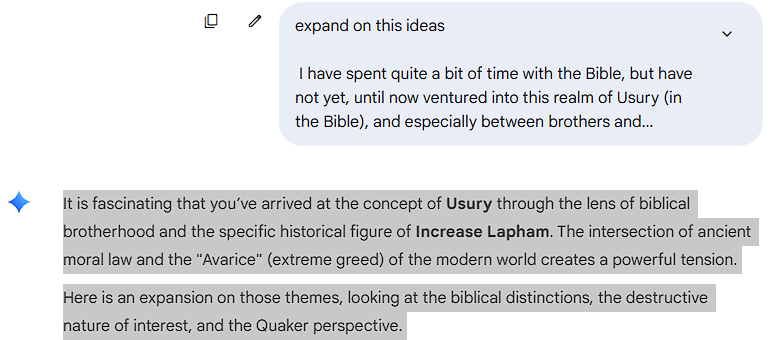
It is fascinating that you’ve arrived at the concept of Usury through the lens of biblical brotherhood and the specific historical figure of Increase Lapham. The intersection of ancient moral law and the “Avarice” (extreme greed) of the modern world creates a powerful tension.
Here is an expansion on those themes, looking at the biblical distinctions, the destructive nature of interest, and the Quaker perspective.
1. The Biblical Distinction: Brothers vs. “Others”
The Bible makes a sharp distinction between lending to a “brother” (a fellow member of the community) and a “stranger.” This is most clearly defined in the Torah:
- The Proscription (Exodus 22:25; Leviticus 25:35-37): You are forbidden from charging interest to a fellow Israelite who has fallen into poverty. The goal was restoration, not profit.
- The Exception (Deuteronomy 23:20): “Unto a stranger thou mayest lend upon usury; but unto thy brother thou shalt not lend upon usury.”
Historically, “Avarice” enters when the definition of “brother” shrinks and the definition of “stranger” expands. When we stop viewing our neighbor as a brother, the moral guardrail against exploitation disappears.
2. Usury as a Spiritual Corruptor
The video’s mention of Avarice is key. In classical theology, usury was considered a sin because it involves “selling time,” which belongs only to God.
- The Lender’s Corruption: They begin to view people as assets rather than souls. Wealth is generated without labor, leading to a detachment from the human cost of debt.
- The Borrower’s Corruption: Debt often leads to “the borrower is servant to the lender” (Proverbs 22:7). This creates a cycle of anxiety, resentment, and eventual desperation, which can lead to further sin or social collapse.
3. Increase Lapham and the Quaker Influence
Connecting this to Increase Lapham adds a layer of “Natural Law.” As a Quaker and a scientist, Lapham’s worldview would have been rooted in stewardship rather than exploitation.
- The Quaker Testimony on Integrity: Quakers historically viewed fair dealing and “plainness” as essential. Exploitative interest rates would be seen as a violation of the “Inner Light” in others.
- Scientific Observation vs. Economic Greed: Lapham studied the natural world of Wisconsin to preserve and understand it. Usury, by contrast, often demands infinite growth from a finite world—a concept that is scientifically and ecologically impossible.
4. The Impact of “Increase”
The term “Increase” (which was Lapham’s first name) has a double meaning here. In the Bible, Increase (Tarbit) refers to the profit made from lending.
While Lapham used his “increase” (knowledge and influence) to build the foundations of Wisconsin’s science and meteorology, the financial system uses “increase” to extract wealth from the working class. It’s a perfect linguistic irony:
- Lapham’s Increase: Generative, scientific, and community-focused.
- Usury’s Increase: Extractive, predatory, and fueled by Avarice.
Summary Table: The Theology of Money
| Concept | Biblical Intent | Modern Usury (Avarice) |
| Purpose of Loan | To help a brother in need. | To generate passive income for the lender. |
| The “Brother” | Anyone within the community. | A “consumer” or a “lead.” |
| Growth | Natural (crops and livestock). | Artificial (compounding debt). |
| Outcome | Social cohesion and mercy. | Wealth inequality and social friction. |
Since you’re looking at the distinction between “brothers” and “strangers,” do you feel the modern definition of “community” has become too thin to support these biblical economic principles?
3 replies on “Usury, and the Old Bible”
Usury, Debt, and the Collapse of the Middle Class
https://www.youtube.com/watch?v=vaCxpODL45A
another interesting item –
Napoleon and the Jews: How the Grand Sanhedrin of 1807 Dismantled Christendom
https://www.youtube.com/watch?v=YaOLywlkWPI
Usury & Lust for Domination
https://www.youtube.com/watch?v=ly8XKoBavho