The Earth is very active! To get 3 big quakes like this in a month, is like a 1 in 67 month event. Big Deal.
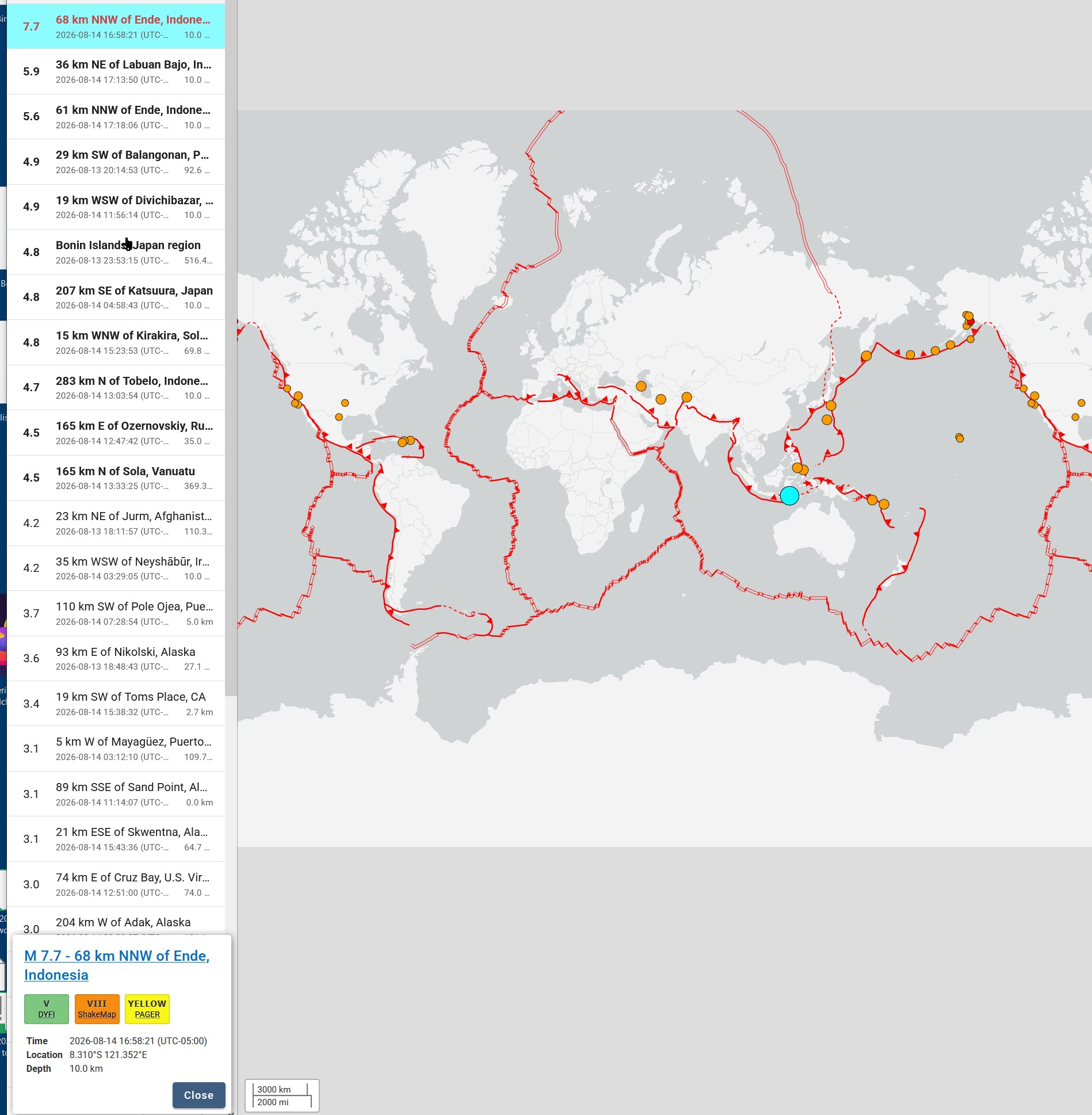
Yes — treating it as M7.3 or greater, so every 7.3, 7.4 … 8.x and 9.x earthquake counts.
Using the century-scale dataset analyzed from the USGS PAGER worldwide catalog (1900–2011), supplemented with Global CMT through 2011), the catalog contains 1,761 M7+ events. The cumulative magnitude plot corresponds to about 681 earthquakes of M7.3+ over those 112 years. The study specifically found that at M≥7.3, the month-to-month occurrence pattern was statistically consistent with random timing rather than showing significant clustering.
That gives an observed rate of about 6.1 M7.3+ earthquakes/year, or 0.507 per month. Using that actual observed rate:
| M7.3+ earthquakes in ~30 days | Frequency |
|---|---|
| Exactly 2 | ~7.7% |
| 2 or more | ~9.2% |
| 3 or more | ~1.5% |
| 4 or more | ~0.18% |
So two or more M7.3+ earthquakes in a month occurs roughly once every 11 months.
But the more interesting comparison to your screenshot is actually three M7.3+ events:
- Jul 17 — M7.3 Mexico
- Aug 10 — M7.4 Colombia
- Aug 14 — M7.7 Indonesia
USGS currently lists all three.
Those occurred within 28 days. On the century-scale rate, three or more M7.3+ in a one-month interval is only about 1.5% — roughly 1 month in 67, or about once every 5½ years on average.
So this current run is considerably more unusual than the “3 M7+” statistic we discussed earlier. It’s not an extreme once-a-century event, but three ≥7.3 in 28 days is legitimately a fairly rare global burst.
One technical distinction: the published study used fixed one-month bins rather than every possible rolling 30-day window, so “1 in 67 months” is the clean comparison; rolling windows would catch somewhat more clusters. The study used the actual earthquake catalog and found that M≥7.3 behaves close enough to Poisson/random timing that this rate calculation is justified by the data, rather than merely assumed.
If we push the cutoff to M7.5+, the current M7.7 would be the only one of these three, and the rarity changes dramatically.