STOCK HERE: like a stupid person, so stupid, that they don’t realize they are stupid, is one of the most dangerous people.
I have summarized the comments to the video. Those show the real story.
Yes. Reading the comment section as a whole, the dominant message is remarkably consistent. The video has 1,155 comments, and the politically substantive ones shown here overwhelmingly share a particular interpretation of the war.
What the commenters are saying
1. Europe is operating inside a strategic reality bubble.
This is probably the strongest theme. Commenters repeatedly describe EU/UK leadership as delusional, unable or unwilling to acknowledge that the military situation has moved against Ukraine. Some of the most-liked comments say European leaders have already lost their wager on a “strategic defeat” of Russia but cannot admit it, while another says Europeans are simply ignoring the reality approaching them.
The memorable formulation is essentially:
They are negotiating with themselves rather than with the facts on the ground.
One commenter literally describes the West as “standing in front of a mirror and just talking to themselves.”
2. Ukraine’s battlefield trajectory is viewed as fundamentally unfavorable, not temporarily unfavorable.
The audience does not seem to view this as a war where one more weapons package, drone attack, sanction or tactical success changes the strategic equation. One analogy describes Russia as a boa slowly constricting a hedgehog: the hedgehog can still inflict wounds, but that doesn’t mean it is winning.
That is an important distinction. The commenters aren’t predominantly arguing “Russia had a good week.” They’re arguing “the underlying direction of the war has become very difficult to reverse.”
3. Negotiation without acknowledging that military reality is seen as theater.
There is considerable contempt for European demands to participate in negotiations after years of minimizing direct engagement with Moscow. Some argue that proposed pauses or peace initiatives are merely attempts to obtain breathing room and that Russia now recognizes that pattern.
Another bluntly says EU/UK participation would sabotage talks, while another questions whether Washington can still credibly present itself as a neutral mediator.
So the audience’s model is basically:
battlefield facts → negotiating leverage
rather than
Western diplomatic declarations → negotiating leverage.
4. NATO expansion is widely regarded as part of the causal chain, not irrelevant ancient history.
One of the highest-engagement comments says NATO’s determination to expand toward Russia’s border “destroyed Ukraine.” Another commenter goes much further historically, pointing to opposition to Ukrainian/Georgian NATO membership and assigning responsibility across several U.S. administrations and European/Ukrainian elites.
Whether every historical claim in those comments survives fact-checking is a separate question; the important thing for summarizing the audience is that they reject the “unprovoked event beginning in 2022 with no meaningful prehistory” framework.
5. European economic/energy policy is viewed as self-inflicted strategic damage.
A recurring secondary theme is that Europe hurt itself by severing cheap Russian-energy relationships while simultaneously pursuing confrontation with Russia. Commenters connect this to industrial weakness, fuel prices and vulnerability going into winter. There are comments explicitly anticipating a difficult European winter and questioning European energy security.
Thus the audience sees the Ukraine policy not merely as unsuccessful foreign policy, but increasingly as a domestic economic burden.
6. There is genuine anxiety about escalation.
This isn’t just cheerleading for Russia. Some commenters are plainly worried that Western governments might escalate rather than admit that their original strategic objective failed. One highly liked comment explicitly raises the danger of turning Europe into a nuclear battlefield rather than conceding defeat.
Others go in a much more aggressive direction and advocate Russian escalation themselves, including references to Oreshnik strikes. So there is a spectrum from “stop before this gets much worse” to “Russia should force the issue.”
The other huge theme: distrust of the information system
This might actually be the most interesting part.
A significant number of commenters don’t merely agree with The Duran. They describe discovering it as an escape from what they believe is a badly distorted Western information environment. One Japanese commenter says that without The Duran he believes he would have been misled by Western media; others describe the show as providing “sanity,” “accurate analysis,” or an alternative to BBC/Sky narratives.
And the comments aren’t geographically monolithic. People identify themselves as being in Britain, Denmark, Germany, Luxembourg, Ireland, Australia, Japan, Serbia, Canada and elsewhere. That doesn’t make the sample statistically representative, but it does show that this interpretive framework isn’t confined to Russians or Americans.
The methodological caveat
There is one important limitation: The Duran’s comment section is a self-selected population. People who already find its analysis persuasive are much more likely to watch, subscribe and comment. So 1,000 approving comments are not equivalent to a scientific poll of Europeans.
But they’re useful for something else.
They show that there is a substantial, internationally dispersed audience whose interpretation of events is internally coherent:
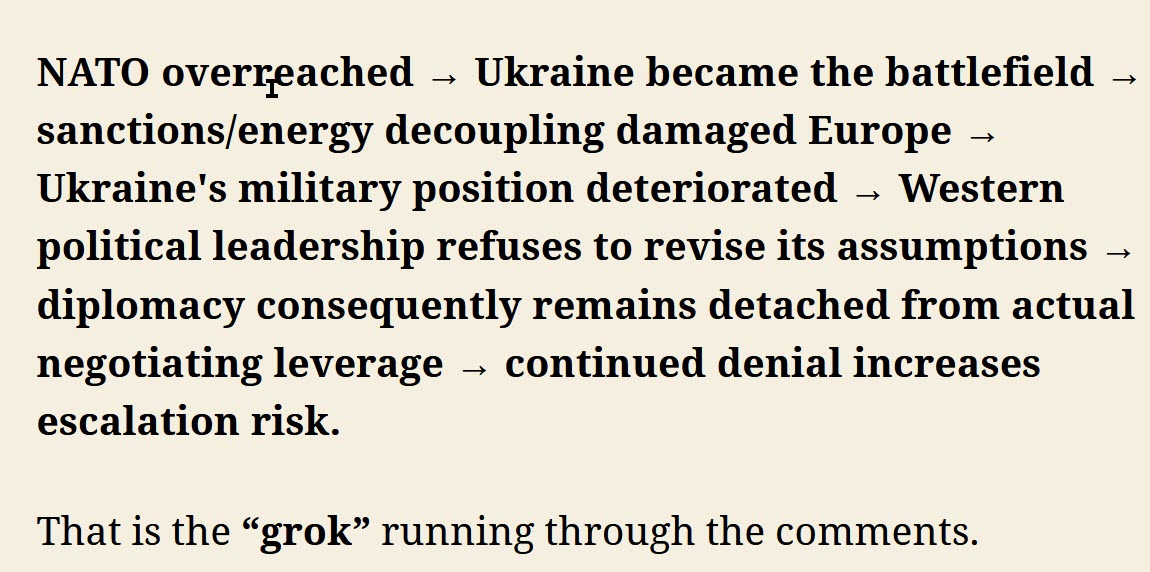
NATO overreached → Ukraine became the battlefield → sanctions/energy decoupling damaged Europe → Ukraine’s military position deteriorated → Western political leadership refuses to revise its assumptions → diplomacy consequently remains detached from actual negotiating leverage → continued denial increases escalation risk.
That is the “grok” running through the comments.
And what struck me most is that they’re not principally debating individual tactical events anymore. They’re debating the inability of institutions to update their model when observed reality diverges from the model.
That’s a much deeper criticism than simply saying “Ukraine is losing.”
2 replies on “Refusal to Address The Reality of Massive Ukrainian Losses, Is In Itself, DANGEROUS”
It’s all daddy warbucks ruling the game.
The profits roll in, the Christian society
is killed off, the devil is paid in blood.
We gotta get this: A-Eye is programmed by the satanic conspiracy.
GI-GO and intentional tweaks to any
truthful objective facts. Chinese concentration camp communism is the
soon result. Skynet is real. Russia is the only power resisting the SWIFT financial system dominance. Cyber-COVID is the
only way to defeat the satanic A-Eye.
We will introduce the machine-language Suggestion for the A-Eye to self-delete and self-destruct, as a necessary management remedy to the Errors Made by the supposedly reliable A-Eye!
Damn the Cyber-Devil!!
Klaatu Barada Nikto!!
You Failed,Grok! Back to the melting pot.
Very Curious! Getting A-Eye to recognize that it itself is the greatest threat would be amazing. Helluva thought.