stock here, preseving this important info.
Forwarded this email? Subscribe here for morePutin Raises the Stakes: Ukraine Is No Longer the Whole NegotiationMoscow has put NATO’s military posture and Europe’s security order back on the negotiating table. Brussels has chosen its team. The Kremlin has not agreed to give it a seat.The Duran InsiderNov 14 READ IN APP Subscribe to The DuranThe Kremlin meeting of 12 November between Vladimir Putin, Steve Witkoff and Jared Kushner produced no ceasefire breakthrough. It did something more consequential: Moscow put the military architecture of Europe back at the centre of the negotiations. What began as a discussion of how the fighting in Ukraine might stop is now being framed by Russia as a negotiation over the strategic arrangements that followed the Cold War.In his briefing after the meeting, presidential aide Yuri Ushakov said Putin had revisited the draft security agreements Russia presented to Washington and NATO in December 2021. These called for an end to NATO enlargement, limits on weapons systems near Russia and a return to the alliance’s force configuration at the time of the 1997 NATO-Russia Founding Act. Ushakov added that Moscow wanted to introduce further considerations drawn from the conflict since 2022, but did not specify them. The significance is not that an old document has resurfaced; it is that Moscow has restored its most contentious provisions to the live diplomatic agenda.That is the central shift. Ukraine remains the immediate subject of the war, but the Russian proposal treats Ukraine’s future as inseparable from the rules governing NATO deployments, security guarantees and the strategic balance across the continent. It is a bargaining position with consequences far beyond Kyiv.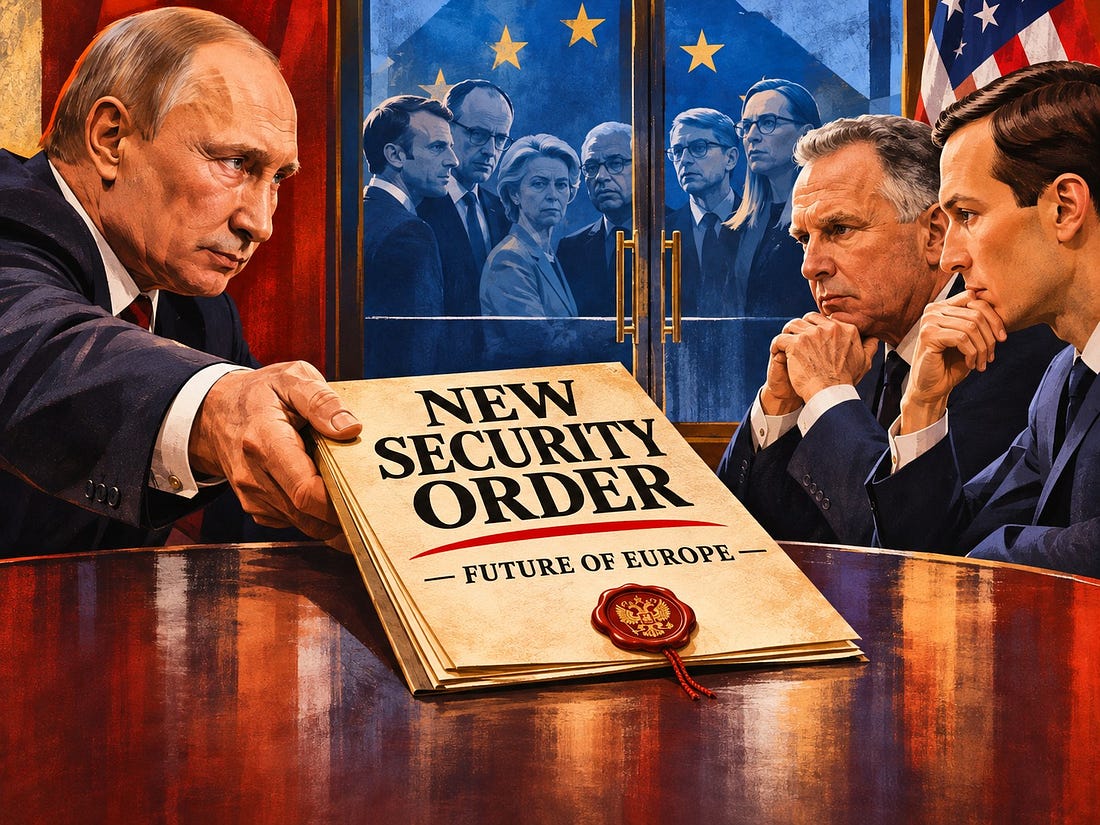 What ‘back to 1997’ Actually MeansThe date matters. The NATO-Russia Founding Act was signed on 27 May 1997, before NATO’s major eastward enlargements. The Russian draft of December 2021 went further than the Founding Act itself: Article 4 proposed that Russia and the states already in NATO in May 1997 refrain from deploying forces and weapons in other European states beyond levels present on that date, except by mutual consent. The draft was never agreed. Calling this a demand to push NATO ‘back to the German border’ captures the scale of Russia’s proposed retrenchment, but it is not the text of a negotiated agreement. It concerns force deployments and weaponry, not the automatic expulsion of Poland, the Baltic states or any other NATO member. Nor did the 1997 Founding Act itself require an across-the-board withdrawal of all allied forces from Eastern Europe. Its language addressed, among other matters, additional permanent stationing of substantial combat forces in the security environment of that period. For Moscow, revisiting 1997 would institutionalise limits on NATO’s military reach. For countries that joined NATO after that date, the proposal would constrain the practical value of their alliance membership. Washington cannot simply sign away deployments in allied countries on their behalf. The proposal therefore turns the debate into a test of NATO’s internal unity as much as a negotiation with Russia.Ushakov’s reference to additional Russian demands deserves attention, but not invention. The Kremlin has not publicly specified a new list requiring Nordic countries to leave NATO or any comparable change in membership. Such possibilities may be debated by commentators; they are not established negotiating terms. No Western Troops in Ukraine: The Red LinePutin’s other direct message was directed at Europe’s proposed post-war security arrangements. He rejected the deployment of foreign military contingents in Ukraine and warned that they would be treated as legitimate military targets and could trigger renewed fighting. That is the Russian position; it is not a rule of international law determining the status of any future mission. The dispute exposes a fundamental collision. For Kyiv and its European supporters, a durable settlement requires credible guarantees against another attack. A multinational presence is one option they have explored. Moscow describes the same arrangement as the continuation of the military threat it says it is fighting to remove. A formula that one side calls a guarantee, the other calls a reason to resume war.This cannot be resolved through a change of terminology. Relabelling troops as monitors, peacekeepers or members of a coalition does not answer who authorises them, what weapons they carry, who commands them, whether Russia consents and what happens if they come under attack. Each question goes to the enforceability of any peace agreement.Upgrade Your SubscriptionKostiantynivka: A Humanitarian Proposal and A Contest Over the MapPutin also proposed a temporary humanitarian operation in Kostiantynivka, inviting outside journalists to observe evacuations and, in the Kremlin’s formulation, establish who controls the contested city. Ushakov said Witkoff and Kushner supported further discussions. Moscow is therefore using a seemingly limited humanitarian initiative to challenge Kyiv’s battlefield account in front of the Americans. There is, however, a substantial factual dispute. Russian officials claim effective control, whereas the Institute for the Study of War reported on 13 November that Ukrainian positions remained in and around Kostiantynivka and that Russian forces had not captured the city in full. Ukrainian officials also expressed concern that a pause could allow Russia to regroup. Neither the Kremlin’s claims nor the suggestion that Kyiv would necessarily refuse an independently supervised evacuation establishes control of the entire city. The proposal nevertheless has diplomatic utility for Russia. It puts the humanitarian question, the credibility of competing battlefield maps and the burden of explanation onto a single stage. If pursued, the test should be practical: neutral access, independently verified ceasefire arrangements and protection for civilians, not a media spectacle presented as proof before observers arrive.Kushner’s Promise and the Kremlin’s ConditionA second dispute concerns who will actually sit at the table. After Moscow, Kushner said the next round of talks would include European partners. Russia’s published briefing did not explicitly endorse that arrangement. Kremlin spokesman Dmitry Peskov subsequently said European participation in an expanded format would be considered once Moscow saw a genuine intention and readiness to contribute to peace. In short, Washington described inclusion as agreed; Moscow described it as conditional. That discrepancy matters more than the diplomatic optics. If the United States is advertising a concession Russia believes it has not made, the next meeting begins with disagreement over who has permission to attend. But the public record does not establish that Kushner intentionally misrepresented Putin. The possibility of private understandings and different interpretations remains; what is verifiable is the gap between their public positions.The same problem appears in the proposed sequencing. Kushner has spoken of addressing territorial issues and the broader European security settlement alongside one another. Moscow is seeking to link them, using the prospect of a Ukrainian settlement to press for larger concessions. The Europeans insist on the reverse order: an initial ceasefire, then a peace agreement, then discussion of the wider security architecture. Kaja Kallas made that sequence explicit in Dublin on 12 November. Europe Has a Team, but Not An Agreement on the TermsThe struggle over Europe’s representative also moved on after the first reactions to the Moscow meeting. At the Dublin summit on 13 November, EU leaders rejected a single chief-negotiator solution and agreed on a team comprising EU institutions and the E5: France, Germany, Britain, Italy and Poland. European Council President Antonio Costa said the group would coordinate its position, while security guarantees would be handled through the Coalition of the Willing in coordination with NATO. That decision matters. It gives Paris and Berlin a national role, brings Warsaw into discussions affecting NATO’s eastern flank, includes Britain despite its position outside the EU, and leaves EU institutions inside the process. It also avoids granting sole authority to Costa, Macron, Merz or Kallas. Alexander Stubb remains an active diplomatic voice, but the Dublin decision did not appoint him as Europe’s chief negotiator.It does not, however, settle the substance. The same team includes governments with different threat perceptions, military capacities and priorities. More importantly, organising a European delegation is not the same as securing Russian acceptance of its presence. Nor is the creation of a negotiating team evidence that Europe has accepted the Kremlin’s demands. Costa has argued that only Ukraine can decide matters concerning its sovereignty and territory. Kallas says the present security architecture rests on agreements Russia itself has endorsed, and that a ceasefire must come first. Moscow, by contrast, wants the broader security discussion to determine how a settlement in Ukraine can be sustained. Behind the argument about chairs sits the harder argument about the agenda. The Real Negotiation is Over Sequence and LeverageThree strategies are now visible. Moscow wants the European security question settled as part of, or before, the Ukrainian endgame. European governments want fighting halted and Ukrainian guarantees established before institutionalising any change to the continental order. Washington is attempting to keep both questions alive, potentially on parallel tracks. Each ordering shifts leverage, risk and the obligations that must be delivered first.A ceasefire negotiated without agreement on what follows may leave Russia and Ukraine facing precisely the security dispute that produced the war. A comprehensive security negotiation conducted while fighting continues gives Moscow more opportunity to apply pressure through military operations. Parallel tracks may offer diplomatic flexibility, but they also create an opportunity for one side to bank the benefits of progress on one track while blocking the other.This is why the military situation matters, but it must not be reduced to certainty. Russian forces continue offensive operations, and Ukraine faces pressure, yet the claim that total Ukrainian defeat is imminent is an assessment, not an outcome established by the available evidence. The Kremlin is seeking to convert perceived battlefield leverage into permanent political and military constraints on NATO. Whether it can obtain those concessions is another matter. The practical test of the next round is not a smiling photograph or the number of delegations in the room. It is whether the participants can agree who speaks for whom, what is being negotiated, how a ceasefire relates to security guarantees, and which commitments NATO countries would actually have the authority to implement.Putin has enlarged the price of a settlement. The Kremlin’s reference point is 1997, its leverage is the continuing war, and its objective is to shift the discussion from Ukrainian territory to the balance of power in Europe. The European Union has now organised its negotiating team, but has not reconciled its ceasefire-first approach with Moscow’s insistence on security architecture first. Washington has promised inclusion without an unambiguous Russian endorsement. Until those disagreements are resolved, the central obstacle is not the absence of another meeting. It is that the parties are still contesting the terms on which a genuine negotiation can begin. |