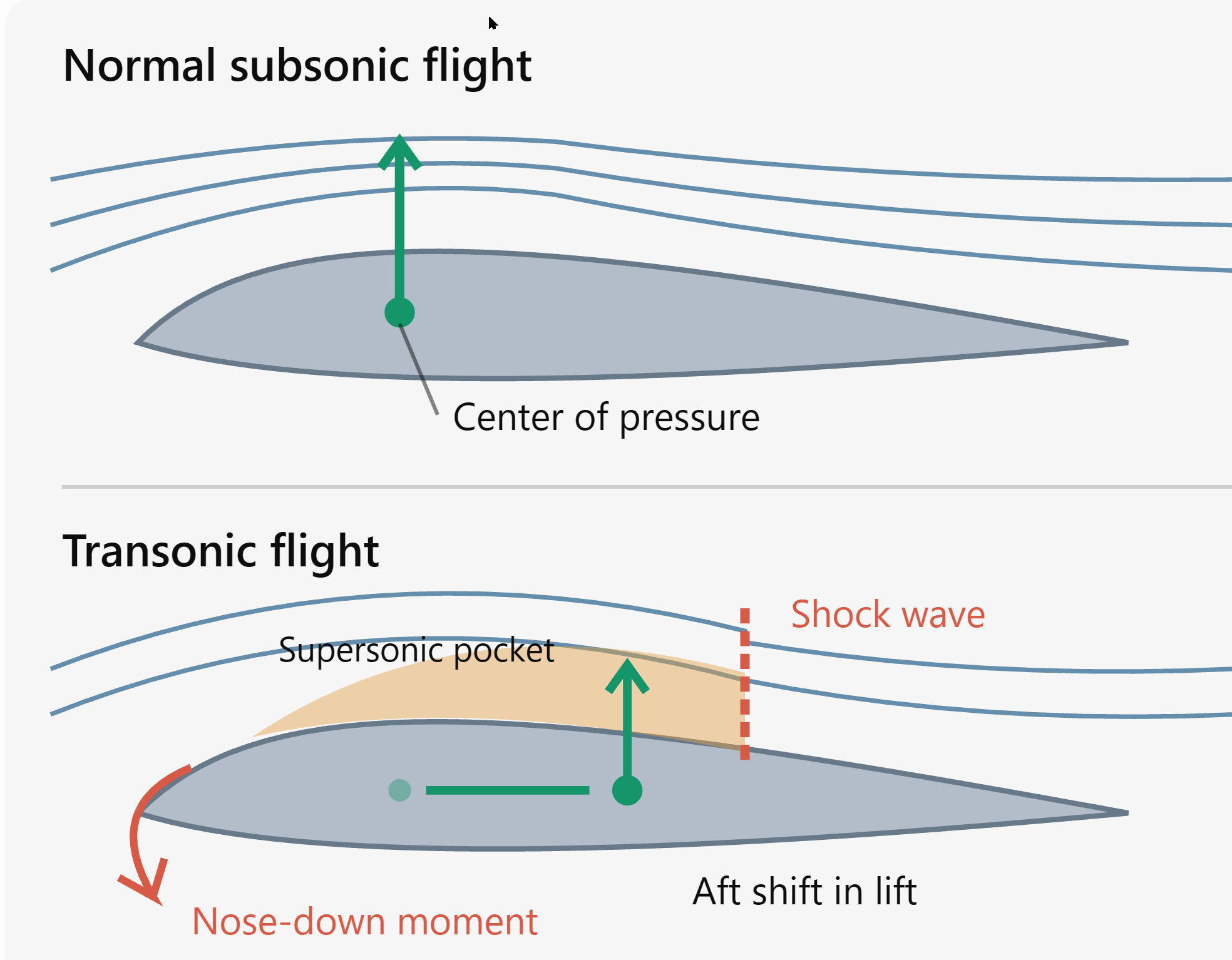
stock here: The early Leerjets were an adaptation of a military jet. The had some unique, and dangerous characteristics, summarized as “Mach Tuck” in which the plane was not supersonic, but sometimes airflow over the wing becomes supersonic in an area, causing the center of lift to move backwards, and thus forcing the nose down. We are talking 1963, think when Kennedy was killed. And back in the day, Leerjet training was super focused on a quick recovery, which involved getting into a tight bank quickly, like no more than 3 seconds.
With the severe turbulence, the 55 year old male probably failed to immediately recognize the Mach Tuck, thinking it was just turbulence, then when it was too late, their dive was out of control, he realized his mistake just as half the tail flight controls, ripped off, and it was all over at that point.
He didn’t spend enough time at the “Learing Center”, ouch!!!!
Here is the basic nature of the “start of the problems”
=========================
The early Learjets had a particularly interesting—and potentially catastrophic—high-speed aerodynamic characteristic known as Mach tuck. It was a consequence of taking a relatively small, extremely powerful business jet into the transonic flight regime.
The original Learjet 23, which first flew in 1963, was substantially different from the conventional business aircraft of its era. Its design heritage came from the Swiss FFA P-16 fighter project. It had excellent climb performance, relatively small wings and the ability to operate at altitudes comparable to commercial jetliners.
The problem was that its aerodynamic characteristics could change substantially as it approached its upper Mach limit.
1. What actually causes Mach tuck?
An aircraft does not need to reach Mach 1 for portions of the airflow over its wings to become supersonic. Air accelerates over the upper wing surface, producing localized supersonic flow while the aircraft itself is still flying at subsonic speed.
Conceptual airfoil diagram showing the redistribution of aerodynamic loading as Mach number increases.
As the Mach number increases:
- Shock waves develop over the wing.
- The pressure distribution changes.
- The effective center of pressure can migrate aft.
- Shock-induced flow separation can change the airflow reaching the horizontal stabilizer.
- A substantial nose-down pitching moment can develop.
The particularly dangerous aspect is the potential positive feedback loop: the nose pitches down, the aircraft accelerates, the Mach number increases, and the nose-down pitching moment becomes stronger.
2. The early Learjet design
Learjet’s Fall From Luxe to Loser Reflects Rising Bar for Swank – Bloomberg
Kampfflugzeug P-16 | aviation.ch
Learjet 23 — 1963
Swiss FFA P-16 fighter
The Learjet combined fighter-like performance with civilian flight controls and operating requirements.
| Characteristic | Learjet 23 |
|---|---|
| First flight | October 7, 1963 |
| Maximum takeoff weight | 12,500 lb |
| Engines | Two GE CJ610 turbojets |
| Total thrust | 5,700 lbf |
| Thrust-to-weight ratio at MTOW | 0.456 |
| Typical high-speed cruise | Mach 0.78–0.80 |
| Service ceiling | 41,000 ft |
In 1965, a Learjet climbed to 40,000 feet in just 7 minutes and 21 seconds with seven people aboard. That was extraordinary civilian aircraft performance for the era. National Postal Museum+2
Unfortunately, its ability to accelerate could exceed its ability to remain controllable.
3. The FAA discovered some alarming numbers
Following a series of Learjet accidents, the FAA conducted a special certification review in 1980–1981.
The findings were more concerning than I would have expected for a certified civilian aircraft.
Learjet 25 high-speed control characteristics
Mach 0.81
Maximum operating Mach number examined
Mach 0.74
Limit with inoperative stick puller
Control-column pull forces
Automatic stick puller
18 lbf
Pitch-axis malfunction
50–60 lbf
Additional force from spoilers
50–80 lbf
Potential total recovery force
150–200 lbf
Source: FAA special certification review, reproduced in NTSB report AAR-81-15. Upper values shown graphically.
Imagine having to exert 200 pounds of pull on a control column while simultaneously trying to maintain lateral control of the aircraft.
The FAA also identified several compounding problems:
- Mach tuck could begin before the maximum operating Mach number was reached.
- Shock waves could reduce elevator effectiveness.
- Elastic stretching of the mechanical control system could negate additional elevator deflection.
- Ailerons could oscillate violently, a phenomenon called aileron buzz or snatch.
- Increasing the G-loading could aggravate lateral control problems.
This was not simply a question of pilot strength. The available aerodynamic control authority itself could deteriorate. NTSB+1
4. The particularly nasty spoiler problem
This is probably the most fascinating engineering aspect of the entire affair.
A pilot experiencing an overspeed condition would instinctively deploy the spoilers to increase aerodynamic drag.
On early Learjets, however, deploying the spoilers at high speed generated a substantial nose-down pitching moment.
Conceptual illustration of spoiler deployment. The actual pitching moment also depends on wing loading, tail airflow and aircraft geometry.
The pilot could actually make the situation worse by deploying a device intended to slow the aircraft.
Even more remarkable, some of the original flight manuals prescribed spoiler deployment as part of the overspeed recovery procedure. Subsequent investigations resulted in explicit warnings against their deployment above the operating speed limits. NTSB+1
5. Coffin corner compounded the problem
Some of the early Learjet 24 and 25 variants were originally certified to fly at 51,000 feet.
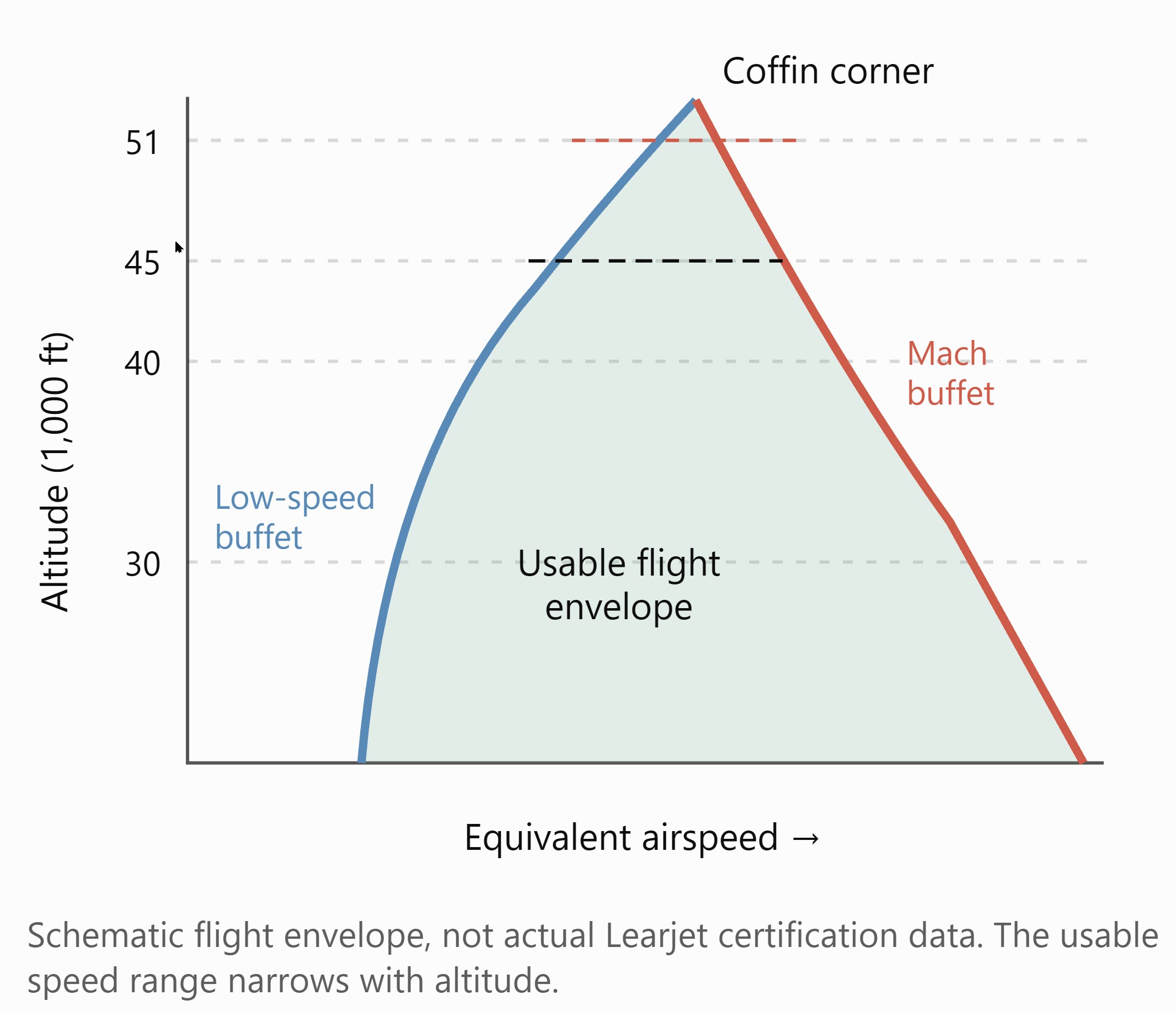
At that altitude, the low-speed stall boundary and high-speed Mach buffet boundary can become uncomfortably close.
Schematic flight envelope, not actual Learjet certification data. The usable speed range narrows with altitude.
A turbulence encounter at extreme altitude could push the aircraft toward either boundary. Increasing load factor during recovery could further reduce the usable envelope.
The FAA subsequently reduced the maximum altitude of affected Learjet 24 and 25 aircraft to 45,000 feet.
6. Documented accidents
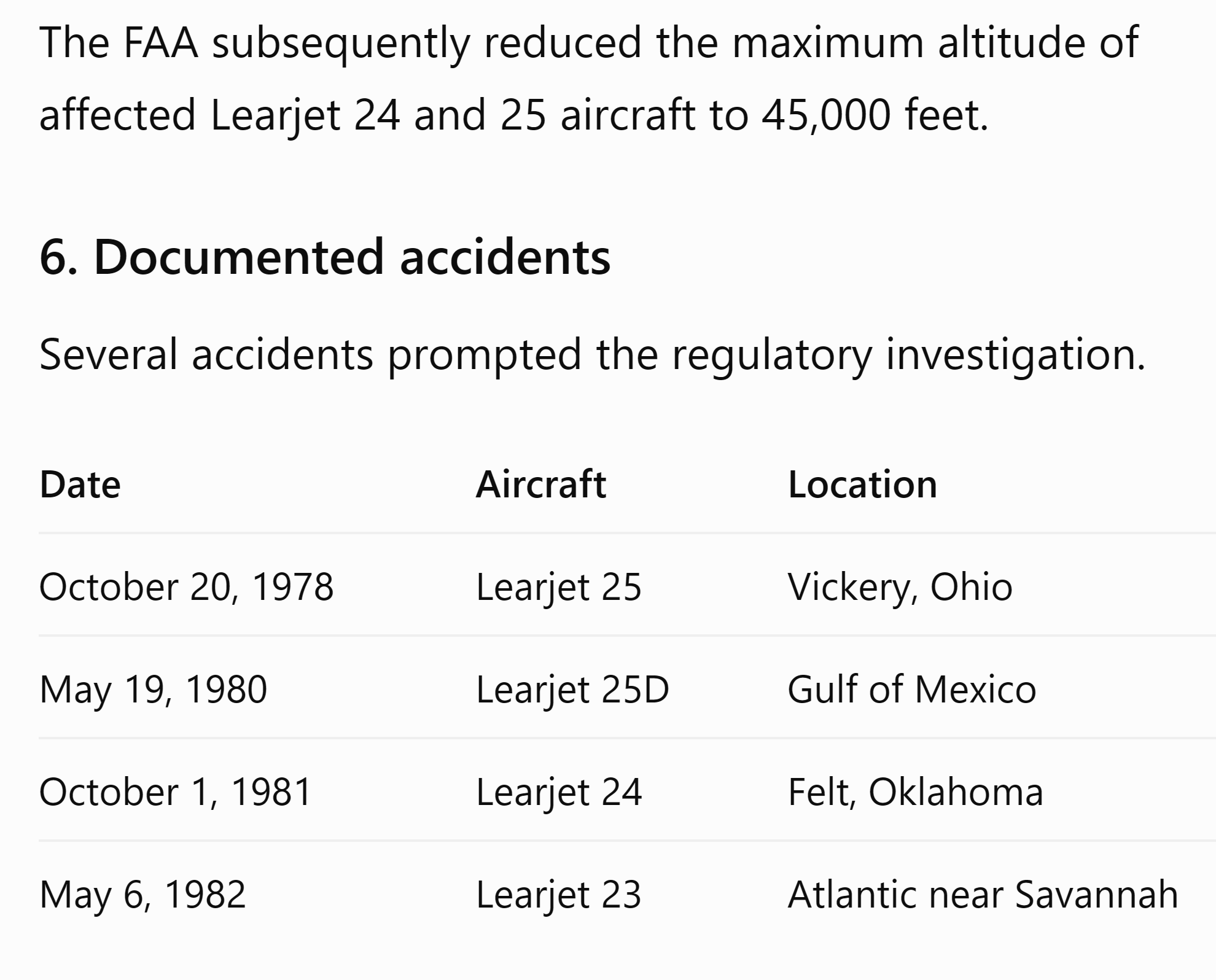
Several accidents prompted the regulatory investigation.
| Date | Aircraft | Location |
|---|---|---|
| October 20, 1978 | Learjet 25 | Vickery, Ohio |
| May 19, 1980 | Learjet 25D | Gulf of Mexico |
| October 1, 1981 | Learjet 24 | Felt, Oklahoma |
| May 6, 1982 | Learjet 23 | Atlantic near Savannah |
The 1980 Gulf of Mexico accident is particularly well documented. The NTSB attributed the loss of control to a combination of clear-air turbulence, improper crew response and inadequate controllability margins near and beyond the high-altitude speed limit.
An unauthorized modification had also disabled the audible overspeed warning. NTSB+2
7. How the problem was addressed
The engineering and regulatory solutions included:
- Stick puller: Automatically applied aft force to the control column near the Mach limit.
- Mach trim: On later models, automatically compensated for Mach-dependent pitching tendencies.
- Revised maximum altitude and speed limitations.
- Pitch-control system modifications.
- Revised spoiler restrictions.
- Improved pilot training and upset-recovery procedures.
- Subsequent improvements in wing design.
The stick puller was fundamentally a preventative device, rather than a device capable of extracting the aircraft from a fully developed Mach tuck.
It is worth qualifying the severity, however. Not every early Learjet had identical characteristics, and a later investigation described the inherent Mach tuck of the Learjet 24 series as relatively mild. It was the interaction of multiple aerodynamic and control-system deficiencies during an overspeed excursion that could make the aircraft exceptionally unforgiving. NTSB Reports+1
8. The engineering lesson
What fascinates me about this aircraft is the simultaneous development of three unfavorable nonlinear relationships:
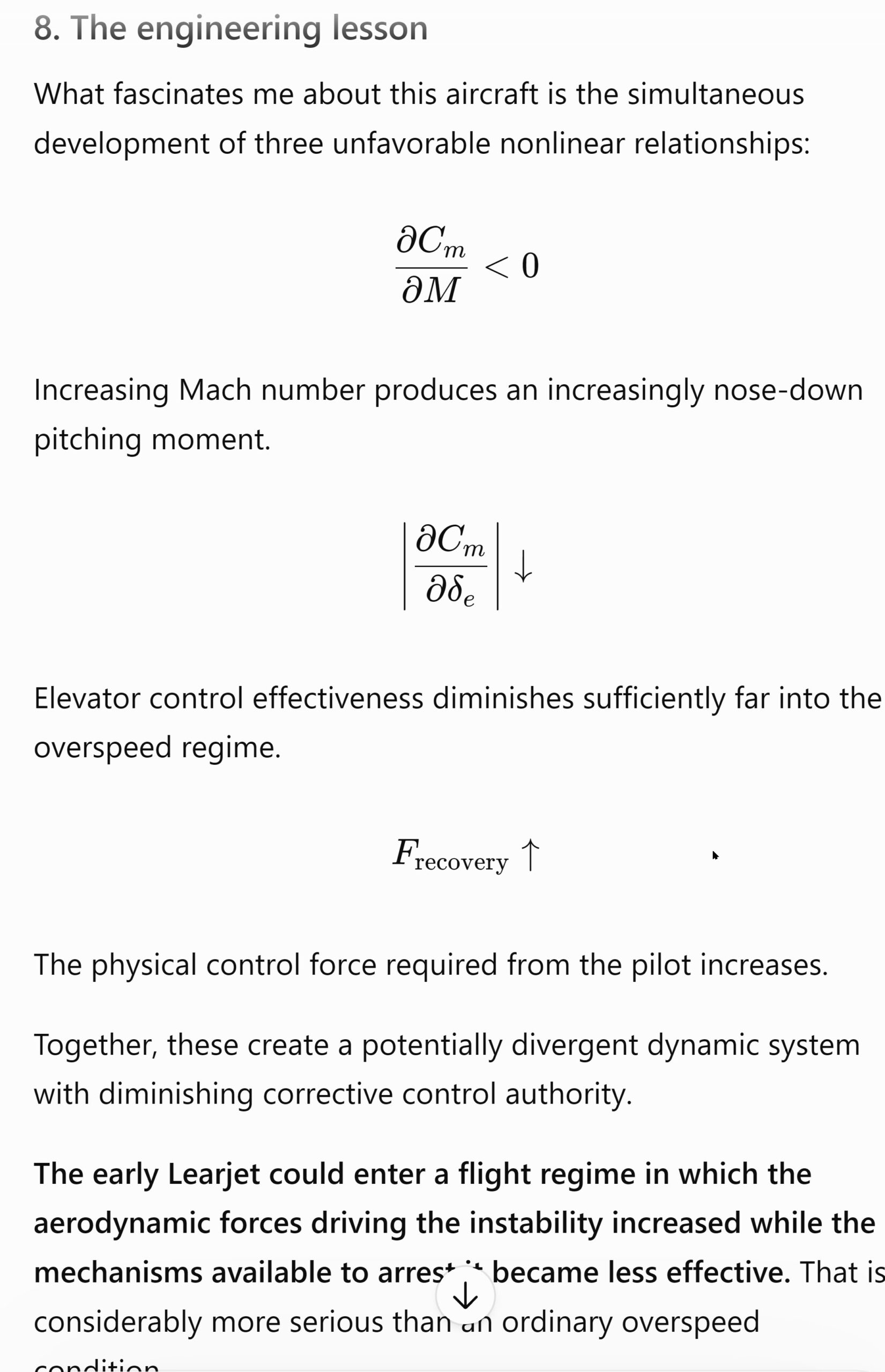
\[ \frac{\partial C_m}{\partial M}<0 \]
Increasing Mach number produces an increasingly nose-down pitching moment.
\[ \left|\frac{\partial C_m}{\partial \delta_e}\right|\downarrow \]
Elevator control effectiveness diminishes sufficiently far into the overspeed regime.
\[ F_{\text{recovery}}\uparrow \]
The physical control force required from the pilot increases.
Together, these create a potentially divergent dynamic system with diminishing corrective control authority.
The early Learjet could enter a flight regime in which the aerodynamic forces driving the instability increased while the mechanisms available to arrest it became less effective. That is considerably more serious than an ordinary overspeed condition.
If you want some excellent technical reading, the original 1981 NTSB accident investigation, AAR-81-15 contains the FAA’s engineering findings. Printed pages 17–19 are particularly revealing.
=========================
LOL. A “Learing Center” specializing in advanced Mach tuck recovery.
Course curriculum:
- Mach 0.81: When a business jet becomes an experimental aircraft.
- Spoilers: How to accelerate downhill while attempting to slow down.
- Applied biomechanics: Pulling 200 pounds while seated.
- Coffin corner: When both faster and slower are wrong.
Tuition includes a complimentary change of underwear.