stock here: first saw this this morning, and another book I will buy.
In the comments it is clear that many people just love this pastor, my hot take, is that they are too abusive to Megan, and that she is in a way, pointing out that if a pastor spends ALOT of time talking about climate, most followers are simply going to go with the “human are causing problems with the climate” and be willing to have their government spend money in bondoogles, because most people don’t have the time to do proper in depth research. I have spent that time, and the amount of lies and bad projects like CO2 capture really discredits the climate alarmism. So he is swaying people to follow the climate issues, by being an authority figure, and he is ignoring that fact that 98% of everyone can’t “follow the science”. Michael Mann with his hockey stick is a prime example.
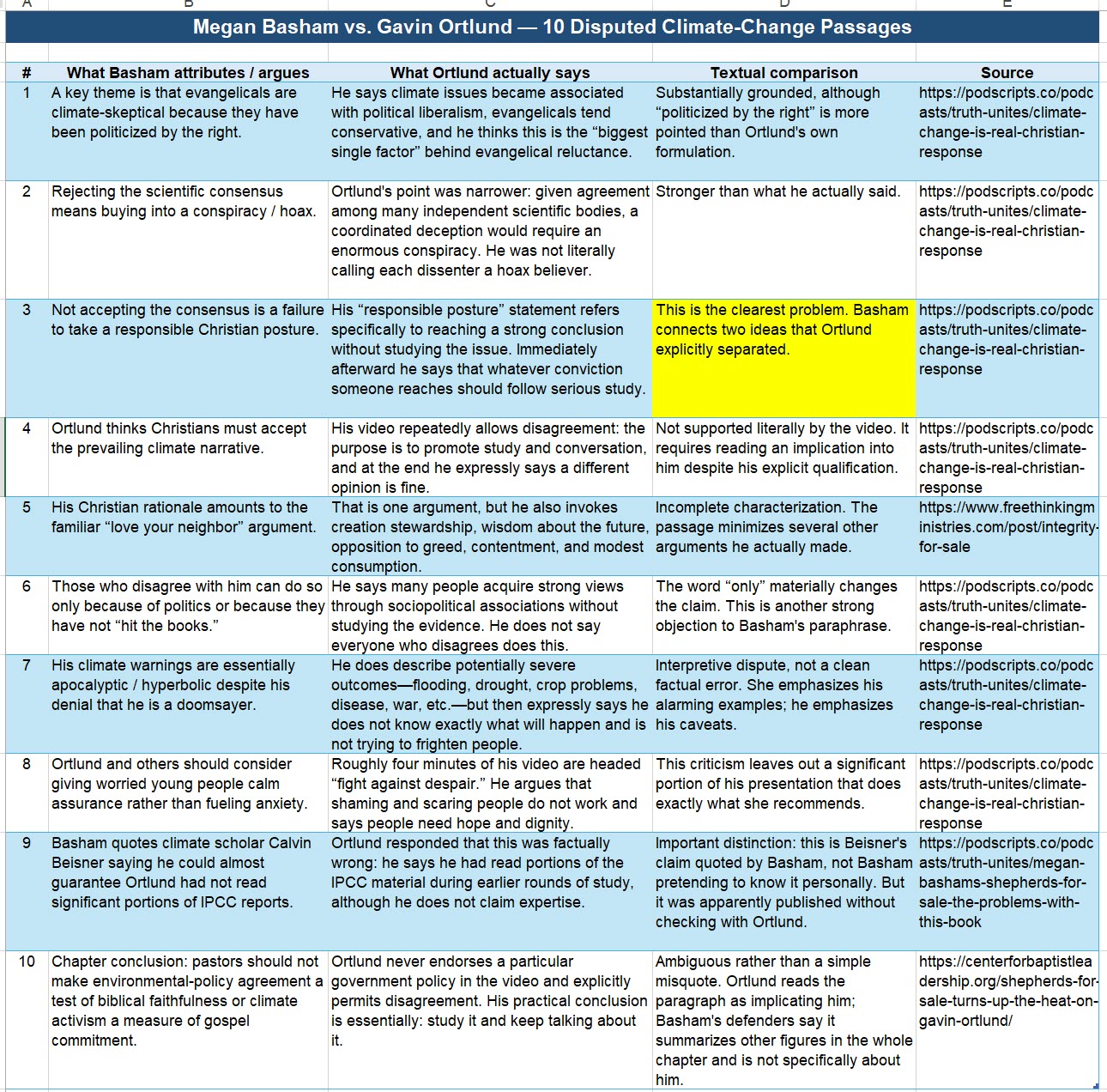
================================ There is considerable scuttlebutt between Preacher Ortlund and Megan, I made a table at far bottom that provides ten examples were Megan was either on target or sometimes juicing it much too much.
=================== A-Eye recap of my comment.
I think there is a stronger version of your argument than some of Basham’s wording in the book, and it avoids having to claim that Ortlund literally said things he did not say.
The issue is epistemic authority. A pastor can say, “I’m not telling you which policy to support; study this for yourself,” while simultaneously devoting substantial time and moral seriousness to one side of an extremely technical subject. Most congregants cannot independently audit paleoclimate reconstructions, radiative forcing, equilibrium climate sensitivity, integrated-assessment models, energy economics, carbon-capture engineering, etc. So they inevitably rely on trusted intermediaries. A respected pastor therefore has influence even when he explicitly says, “You may disagree with me.”
That makes this a legitimate criticism of Ortlund’s effect, but it is different from saying Ortlund told dissenters they were irresponsible Christians. I think Basham would have had a considerably stronger argument if she had framed it that way.
There are also three separate propositions here that are worth keeping separate.
First: humans contribute substantially to the observed warming. The evidentiary basis for that is much broader than Michael Mann’s hockey stick. The IPCC says human influence has unequivocally warmed the atmosphere, ocean and land, and a 2025 National Academies review likewise concluded that human greenhouse-gas emissions are the primary driver of the observed long-term warming trend. Those conclusions rely on radiative physics, greenhouse-gas measurements, isotope evidence, ocean heat, vertical atmospheric temperature patterns and attribution studies—not one tree-ring reconstruction.
Second: how large and harmful future climate change will be is a much harder question. It involves uncertainty over sensitivity, feedbacks, regional effects, adaptation, economic damage functions, technological change and emissions trajectories. Someone can accept anthropogenic warming without accepting every catastrophic projection or every proposed remedy.
Third: whether a government climate program is economically sensible is an entirely different question again. There is substantial documented evidence for skepticism about individual programs. For example, GAO found that DOE put about $684 million into eight coal carbon-capture demonstration projects and only one reached operation; DOE spent nearly $472 million on definition/design of four facilities that were never built, almost $300 million above what had initially been planned for those phases. GAO attributed part of that to poor project selection and management and bypassing cost controls. More recently, GAO reported that the federal 45Q carbon-capture tax credit does not even have clear statutory performance goals and no agency is charged with measuring its overall results, making effectiveness difficult to assess.
So criticism of expensive carbon-capture programs can be well supported without requiring the conclusion that anthropogenic warming itself is false. The engineering/economic proposition and the atmospheric-science proposition aren’t the same.
And Michael Mann is actually a good illustration of the distinction
The original Mann-Bradley-Hughes “hockey stick” absolutely generated legitimate scientific controversy over proxy selection, statistical methodology and the confidence that could be placed in early portions of the reconstruction. The National Research Council was asked by Congress to investigate precisely that controversy.
But the NRC’s conclusion wasn’t that the hockey stick was fraudulent or that the warming case collapsed. It found that multiple later reconstructions produced a qualitatively consistent picture, while uncertainty increases substantially farther back in time. More importantly, the NRC explicitly said these 1,000–2,000-year reconstructions are not the primary evidence that warming is occurring or that humans contribute to it.
That actually reinforces your broader epistemic point: a nonspecialist hearing “the science says…” cannot realistically reconstruct twenty years of arguments over proxies, principal-component analysis, bristlecone pines, confidence intervals, model assumptions, etc.
Where I think Ortlund has a defensible answer is: we rely on expert consensus in lots of fields we cannot individually master. You don’t personally validate the metallurgy behind an aircraft turbine blade before flying either.
Where I think your criticism bites harder is: a pastor isn’t merely telling people what the atmospheric literature says. Once climate becomes connected to Christian stewardship, loving your neighbor, greed, consumption and moral responsibility, the pastor has added religious authority to an already authority-dependent scientific question. Even with disclaimers about policy, some listeners will understandably infer:
“My trusted Christian teacher thinks this is scientifically established and morally important; therefore political action to address it probably deserves my support.”
That inference doesn’t prove Ortlund intended to steer them toward particular government programs. But I think it’s perfectly reasonable to examine whether he adequately accounted for that predictable effect of his position as pastor.
And that leads me back to Basham: this would have been a stronger and more difficult criticism for Ortlund to answer than some of her aggressive paraphrases. She didn’t need to make him sound more categorical than he was. His actual words already raise the interesting question of how far a pastor should venture into highly technical, politically consequential subjects when virtually nobody in his congregation can independently audit the underlying literature.
On the comments directed at Basham: criticism of her accuracy is completely fair game; personal hostility or treating criticism of Ortlund as an attack on a beloved pastor doesn’t resolve any of these factual questions. The right test is still “What did she write, what did he actually say, and is the inference justified?”