stock here: my idea how AI and co-opted post modernism can create a dystopian society.
The Ministry of Context
By 2084, nobody said that photographs lied.
That would have been an embarrassingly primitive way to put it.
Photographs were situated.
Video was constructed.
Memory was privileged narrative.
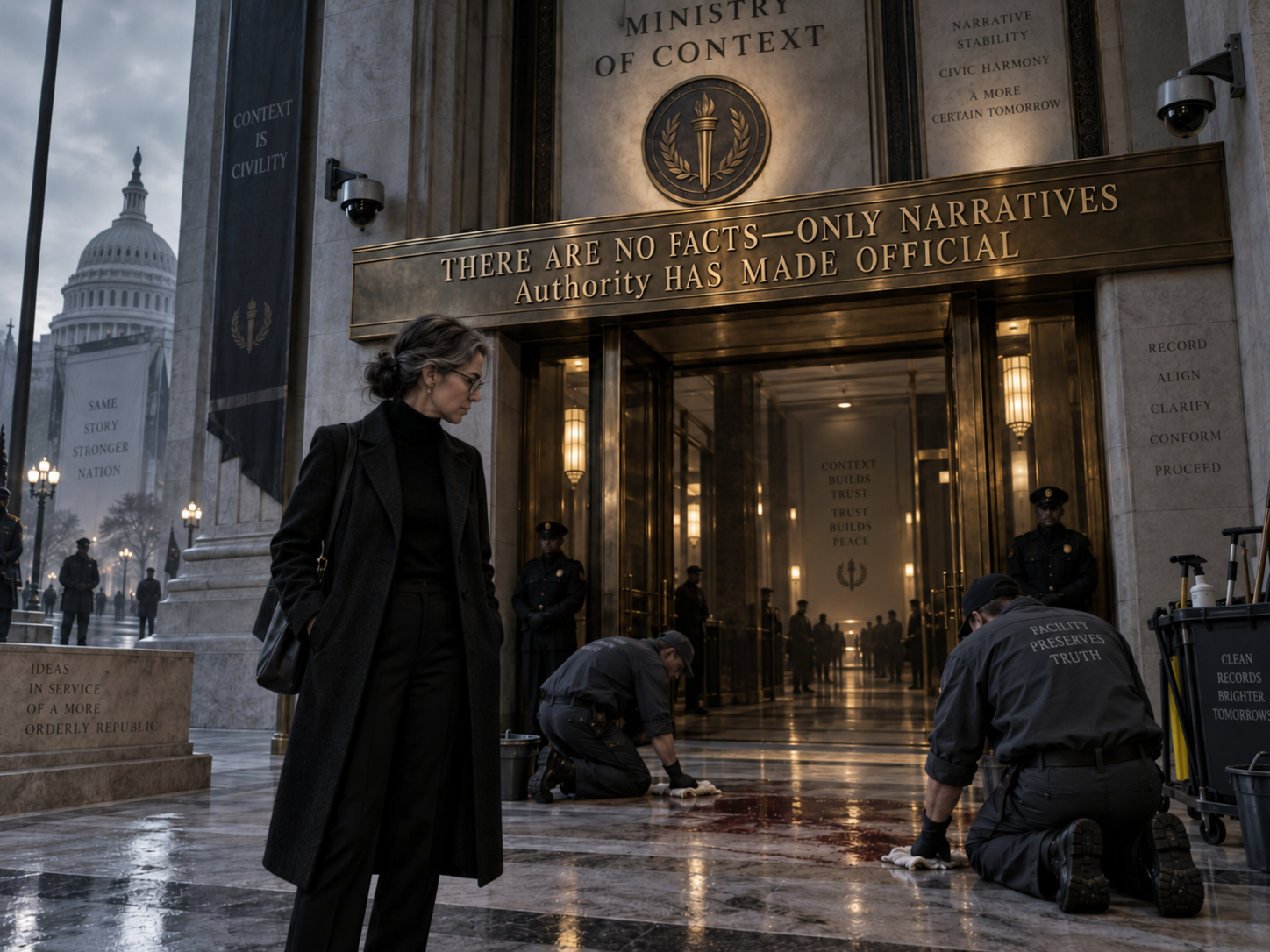
And facts, according to the brass lettering over the entrance to the Ministry of Context, were merely:
CLAIMS TEMPORARILY STABILIZED BY POWER.
Dr. Elena Voss had written those words twenty years earlier.
At the time, she had been a professor of cultural theory at New Columbia University, wearing black turtlenecks and lecturing sleepy undergraduates about Foucault, Derrida, narrative dominance, and the arrogance of objective truth.
She had meant the slogan as a warning.
Someone was “Getting Dangerous”
Now it was government policy.
Elena stood beneath the enormous brass letters and watched workers remove a darker stain from the marble floor.
“What happened?” she asked.
The janitor glanced at the security camera.
“Nothing.”
Elena looked down. The stain was brownish-red.
“I can see something happened.”
The janitor smiled nervously.
“Then perhaps you should ask yourself why you feel the need to impose that interpretation.”
He pushed his cart away.
Elena watched him go.
That sentence, too, had once been hers.
The Ministry of Context occupied fourteen city blocks in what had once been Washington, D.C.
Its purpose was not censorship.
Everyone understood that censorship was fascist.
The Ministry merely provided interpretive safety.
Every public statement, photograph, video, historical document, courtroom recording, scientific result, and eyewitness account could receive a Context Classification.
Green meant socially coherent.
Yellow meant disputed.
Red meant potentially harmful without interpretive supervision.
Black meant epistemically violent.
Black material technically remained legal to possess.
You simply could not transmit it, quote it, display it, describe it, or acknowledge having seen it.
This distinction was considered important.
Elena’s former student, Marcus Hale, now served as Deputy Minister for Epistemic Justice.
He was forty-two, handsome, cheerful and relentlessly reasonable.
He greeted Elena in his office with both arms extended.
“My favorite heretic.”
“You invited me.”
“I invite people I disagree with. It’s how democracy works.”
He poured coffee.
Behind him stood a screen displaying the Ministry’s newest public campaign.
A smiling multiracial family sat around a dinner table beneath the words:
CERTAINTY IS THE FIRST STEP TOWARD HATE.
Elena studied it.
“Do you believe that?”
Marcus laughed.
“You wrote half the intellectual architecture behind it.”
“I wrote that certainty should be questioned.”
“Exactly.”
“I didn’t write that evidence should be ignored.”
“Evidence according to whom?”
Elena stared at him.
Marcus raised a finger.
“There. That expression. You still think there’s some neutral place outside culture where you can stand and pronounce what happened.”
“Sometimes something simply happens.”
“Naïve realism.”
“If I push you out that window, you fall.”
“Probably.”
“You don’t become a competing interpretation of gravity.”
Marcus smiled.
“That is why I miss having you around.”
Then his expression changed.
“You’ve seen the Orchard footage?”
Elena had.
Everyone had, although officially nobody had.
Three days earlier, an anonymous account had uploaded forty-seven seconds of video from Orchard District, an agricultural resettlement zone two hundred miles west of the capital.
The images were unstable.
Night.
Floodlights.
Soldiers.
People kneeling beside a trench.
Gunshots.
Bodies falling.
The government declared the footage synthetic within nineteen minutes.
Two hours later, an independent laboratory announced that it was probably authentic.
By midnight, four other laboratories had declared the independent laboratory itself nonexistent.
By morning, videos appeared showing the same scene from different angles.
Then came another video proving that those angles were generated.
Then a recording of the Minister of Agriculture apparently ordering the executions.
Then an audio expert saying the recording was fake.
Then a video of the audio expert admitting he had been pressured.
Then another video in which the expert claimed the confession video was fake.
Within forty-eight hours, nobody knew anything.
Which, Elena increasingly suspected, was precisely the point.
Marcus tapped his desk.
“The Orchard material has been classified Black.”
“Why?”
“Potential for retaliatory violence.”
“Did the killings happen?”
Marcus sighed.
“That question assumes a stable event beneath competing narratives.”
“Were people shot?”
“Elena.”
“Were they?”
“We have reports.”
“Bodies?”
“Images of bodies.”
“Families?”
“Claimants identifying as families.”
She leaned forward.
“What does that even mean?”
“It means grief doesn’t automatically confer epistemic authority.”
For the first time, Elena felt afraid of him.
Not because Marcus was angry.
Because he wasn’t.
Noah Reyes was seventeen and repaired ventilation drones underneath the Ministry.
He had never read Foucault.
He could barely spell Derrida.
But he understood machines.
And machines left traces.
Every AI-generated image passed through processing systems. Every editing tool introduced artifacts. Every camera sensor had microscopic imperfections.
Reality, Noah liked to say, had fingerprints.
His older sister Sofia lived in Orchard District.
Or had.
Nobody could tell him.
For three days he had submitted requests to the Ministry.
Request for confirmation of resident status.
Returned:
Category error: “resident” presupposes territorially fixed identity.
Request for confirmation of detention.
Returned:
Detention is a historically loaded term.
Request for confirmation of death.
Returned:
Your inquiry may reproduce harmful binaries between presence and absence.
On the fourth day Noah stopped asking.
He started looking.
He pulled maintenance logs.
Satellite bandwidth records.
Drone charging histories.
Emergency electrical demand.
Transportation manifests.
He discovered that on the night of the supposed fake massacre, twelve military drones had landed in Orchard.
Seven refrigerated trucks had arrived.
The district’s electrical grid recorded a massive floodlight load between 1:12 and 3:41 a.m.
The next morning, municipal wastewater usage dropped by thirty-one percent.
People could fake video.
They could fake audio.
They could fake photographs.
But somebody had forgotten to fake the electric meter.
Noah copied everything.
Then he went upstairs to find Elena Voss.
She was sitting alone in the Ministry cafeteria.
Noah dropped a tablet beside her soup.
“My sister is dead.”
Elena looked up.
“You don’t know that.”
“I know.”
“How?”
He showed her.
She scrolled slowly.
Truck manifests.
Power records.
Drone telemetry.
Cellular devices disappearing simultaneously.
One hundred eighty-three phones active Tuesday.
Forty-one active Wednesday.
Elena felt cold.
“Where did you get this?”
“Systems nobody thinks are political.”
She looked at him.
“Everything is political now.”
“No. That’s the trick.”
“What?”
“If everything is political, then nothing can prove anything.”
Elena stared at the boy.
Twenty-five years of scholarship suddenly compressed into one horrible sentence.
If every witness had a perspective, witnesses could be dismissed.
If every image could be manipulated, images could be dismissed.
If every institution embodied power, institutions could be dismissed.
If language never perfectly captured reality, language could be dismissed.
The philosophy originally intended to challenge abusive authority had become the perfect armor for abusive authority.
Not because it proved the government innocent.
Because it made innocence and guilt equally unknowable.
The door opened.
Marcus Hale entered.
He saw Noah.
Then the tablet.
His smile disappeared.
“Elena.”
She stood.
“Did Orchard happen?”
Marcus glanced toward the cameras.
“There are responsible ways to discuss complex situations.”
“Did Orchard happen?”
“You’re collapsing a multilayered conflict into—”
“Did your government kill those people?”
Marcus’s jaw tightened.
Noah lifted the tablet.
“We have the utility records.”
Marcus looked at him with something almost like pity.
“Records are institutional products.”
“It’s an electric meter.”
“Which exists within an administrative regime.”
“Seven freezer trucks.”
“Metadata can be fabricated.”
“The drones?”
“Synthetic logs.”
“The phones?”
“Selective dataset.”
Noah slammed his hand on the table.
“My sister was there!”
Marcus remained calm.
“And your emotional proximity makes you especially vulnerable to narrative closure.”
For several seconds nobody moved.
Then Elena began laughing.
Marcus frowned.
“What?”
She laughed harder.
Not because anything was funny.
Because she finally understood.
“You did it.”
“Elena—”
“No. I don’t mean Orchard.”
She pointed around the cafeteria, the Ministry, perhaps the entire country.
“You built a machine that can never be wrong.”
Marcus said nothing.
“If evidence agrees with you, it’s evidence. If evidence contradicts you, it’s constructed. If a witness supports you, they’re heard. If they contradict you, they’re situated. If video helps you, it’s documentation. If video hurts you, it’s synthetic.”
“Elena, epistemology is more complicated than—”
“No.”
She walked closer.
“Reality is complicated. Epistemology is complicated. But a bullet entering a human skull is not a discourse.”
Marcus lowered his voice.
“You’re becoming dangerous.”
And there it was.
Not incorrect.
Not mistaken.
Dangerous.
The final category.
Elena and Noah released the records that evening.
The government did not deny them.
Denial was obsolete.
Instead, the Ministry issued a statement.
It said the documents had generated “important conversations.”
It warned against “premature factual closure.”
It appointed a Commission for Plural Truths.
It encouraged citizens to resist “binary narratives of perpetrator and victim.”
Within hours, social media filled with arguments.
Some said the massacre happened.
Others said it was AI.
Some said Noah was a government plant.
Others said Sofia had never existed.
A popular professor released a twelve-minute video explaining that obsession with whether people had literally been killed reflected “corporeal essentialism.”
It received eleven million views.
For two days Elena believed they had failed.
On the third morning, something unexpected happened.
An electrician in Ohio posted a power graph.
Then a truck mechanic posted a repair invoice.
A nurse uploaded a missing-patient roster.
A farmer shared soil photographs from Orchard.
A telecom engineer published tower logs.
None of them tried to explain what reality meant.
They simply described what they had seen.
Small facts.
Stubborn facts.
Boring facts.
Thousands of them.
The Ministry classified them Black.
There were too many.
For years the government had trained citizens to distrust grand narratives.
It had never considered what might happen when citizens began assembling reality from tiny pieces that did not require interpretation.
The slogan appeared first on a warehouse wall outside Baltimore.
Nobody knew who painted it.
It was only six words.
By evening it appeared in Chicago.
Then Denver.
Then Boston.
Then on the marble outside the Ministry of Context.
Workers painted over it.
Someone painted it again.
SOMETHING HAPPENED WHETHER YOU BELIEVE IT OR NOT.
Elena stood across the street and looked at the words.
Noah stood beside her.
“Is that objectively true?” he asked.
She smiled.
“Don’t get philosophical with me.”
Across the plaza, Ministry employees emerged carrying buckets of gray paint.
Behind them, enormous brass letters still declared:
CLAIMS TEMPORARILY STABILIZED BY POWER.
Elena looked from the brass slogan to the wet graffiti underneath.
For the first time in many years, she knew exactly which sentence she trusted.
Not because anyone had authorized it.
Not because it was kind.
Not because it was useful.
Because somewhere beneath language, beneath ideology, beneath images and algorithms and competing narratives, the world still possessed the infuriating habit of having actually happened.