A return of a lawful, limited, accountable, and Constitutional government which is God’s servant, rather than His enemy or His competitor for the allegiance, obedience, affections and worship of the Sovereign People, “We the People”
12.3 Any attempt by government to use judicial process or administrative enforcement to enforce any civil obligation derived from any source OTHER than express written consent or to an injury against the equal rights of others demonstrated with court admissible evidence. See Form #09.073 and Form #12.040.
12.4 Offering, implementing, or enforcing any civil franchise (Form #05.030). This enforces superior powers on the part of the government as a form of inequality and results in religious idolatry. This includes making justice into a civil public privilege (Form #05.050, Section 5.3) or turning CONSTITUTIONAL PRIVATE citizens into STATUTORY PUBLIC citizens engaged in a public office and a franchise (Form #05.006).
Not only would the above be INJUSTICE, it would outlaw HAPPINESS, because the right to absolutely own private property is equated with “the pursuit of happiness” in the Declaration of Independence, according to the U.S. Supreme Court. See Form #05.050 for the definition of “justice”. Click here to view a video on why all franchises produce selfishness, unhappiness, inequality, and ingratitude.
President Obama summarized the SEDM Mission Statement in the following video.
stock here: this one has 2.9M views and over 10,000 comments. I am not promoting this person or channel, I am not sure how I feel about it, it almost feels like an apologist for transhumanism, by expressly stating that from the get go, the use of fire by early man was the start of “transhumanism”. And the long segways to the female tech developer using Amazon Web Services for facial recognition and “lie detecting”.
I posted this before, but it is so clear, it needs to be shown again. I found a YouTube and posted at the far bottom.
She blends geopolitical analysis with spiritual conviction, urging audiences to remember that the human soul cannot be coded, cloned, or uploaded. Her message is not one of fear, but of remembrance — that consciousness itself is sacred.
This seems to be the longest version of this speech,
Laura Aboli: Guarding the Human Soul in the Age of Transhumanism
Laura Aboli has emerged as one of the clearest voices warning against what she calls “the final frontier of human control” — the transhumanist agenda. Through speeches, interviews, and articles, she blends geopolitical analysis with spiritual conviction, urging audiences to remember that the human soul cannot be coded, cloned, or uploaded. Her message is not one of fear, but of remembrance — that consciousness itself is sacred.
The Voice at the Better Way Conference
Aboli’s most recognized appearance came at the Better Way Conference 2023 in Bath, UK, hosted by the World Council for Health. Her talk, titled “Transhumanism: The End Game,” was a passionate plea to preserve the integrity of human life and spirit amid technological acceleration. She warned that the fusion of AI, genetic editing, and biometric control systems could lead not to liberation but to enslavement if humanity forgets its divine origin.
Watch her full speech here: Better Way Conference Talk on YouTube
Beyond the Stage: Interviews and Conversations
Following the conference, Aboli’s ideas spread widely through podcasts and independent media. On platforms such as the Tenpenny Podcast and Rumble, she continued unpacking the philosophical roots of transhumanism — tracing its lineage from technocratic utopianism to modern-day digital governance. Her conversations often turn toward personal sovereignty, divine consciousness, and the forgotten language of compassion in political life.
Listen to an in‑depth interview: The Tenpenny Podcast – Laura Aboli Interview
Written Works and Essays
While best known for her oratory, Aboli also writes essays that blend social critique with spiritual discernment. Her 2025 article “Truth about Iran,” published on Energy Update, examined geopolitics through the lens of moral responsibility and collective awakening.
Read the article: Truth about Iran by Laura Aboli
The Spiritual Thread
At the heart of Aboli’s message lies a conviction that human beings are not merely biological machines. She invokes classical philosophy and faith traditions to remind listeners that our capacity for love, intuition, and creativity points to something eternal. In her words, “The ultimate rebellion is to stay human — to feel, to pray, and to refuse to let the algorithm define our worth.”
Legacy and Continuing Work
Through her organization, the United Democratic International Movement for Awareness and Freedom, Laura Aboli continues to speak across Europe and online, inspiring a community of thinkers, activists, and believers who view the defense of humanity as a sacred duty. Her work straddles philosophy, politics, and mysticism — a rare synthesis in an age that often demands conformity over conscience.
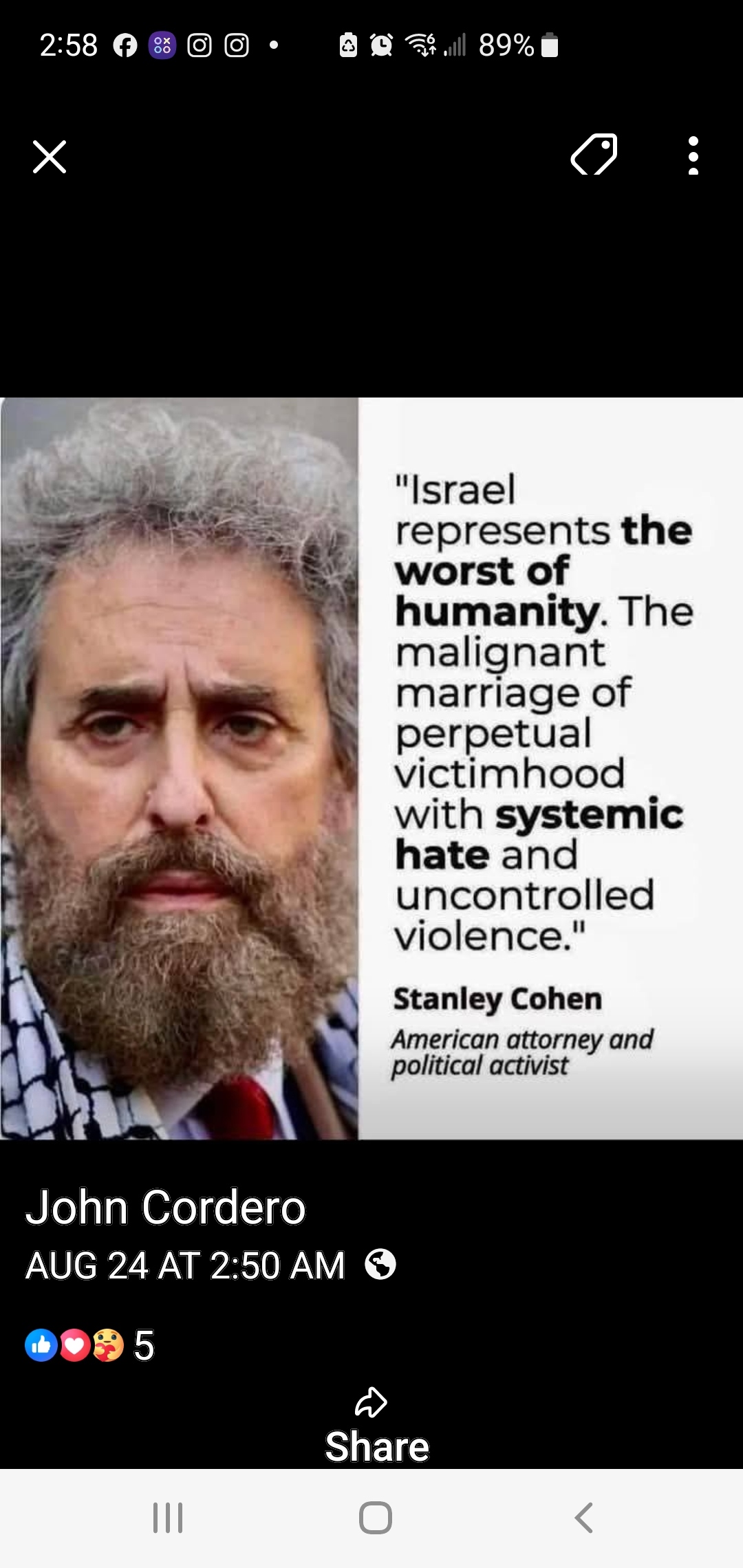
stock here, name of Cohen almost for sure a jew. Bing!!!
Stanley Cohen was born in 1950 and raised in Port Chester, New York, in an Orthodox Jewish family. He attended Hebrew schools and had a bar mitzvah. The Forward
He later described himself as a “non-religious spiritual Jew.”
Ethnicity/race: He is Jewish by upbringing/heritage (Orthodox background). The Forward
His political affiliation: He is not widely identified with a mainstream U.S. political party; his self-description emphasizes radical defense work. Professional role: He is an attorney, and describes himself as an advocate for clients “the government would like to silence or put in jail.” istanleycohen.org +1
🧑💼 Major Activism & Legal Work
Cohen has represented high-profile and highly controversial clients: members/leaders of Hamas, Hezbollah, a relative of Osama bin Laden, and detainees at Guantánamo Bay. Wikipedia +1
He has written opinion pieces for Al Jazeera and appears regularly in Middle-East forums, criticizing Israeli policy and U.S. foreign-aid policy toward Israel. Al Jazeera +1
Example: In 2014 Cohen pleaded guilty to tax charges—specifically obstructing the IRS and failing to file required returns; he was sentenced to 18 months in prison. Wikipedia +1
⚠️ Controversies & Criticisms
His legal defense of clients tied to designated terrorist organizations has drawn significant backlash and accusations of being a “terrorist mouthpiece.” Wikipedia
His writings and public comments include vehement criticism of Israeli policies; some of those critics allege he uses provocative language about Zionism and Israel. The Forward
His tax conviction impacted his law license. Wikipedia
🔍 Why He’s Noted in Context
Cohen is particularly relevant when analyzing:
U.S. legal-defense strategy for unpopular/terror-linked clients
U.S.–Middle East political criticisms and activism around Palestine/Israel
The intersection of U.S. civil-liberties law (defense of “unpopular” defendants) and global human-rights/terror-law concerns
—————————–
To prevent an abusive Judiciary, why shouldn’t the unliked and outliers have excellent defense attorneys?
✅ The Good
Cohen has represented clients and groups that are deeply unpopular or marginalised and says he does this intentionally: “I will not take a major case unless I identify with the client’s politics and like them.” Wikipedia+1
He writes regularly for outlets like Al Jazeera, contributing opinion pieces on human-rights issues, media freedom, and Palestine/Israel which raise perspectives often under-represented in mainstream U.S. coverage. For example: “The lone wolf of Gaza” (Oct 2016) and “BDS is a war Israel can’t win” (July 2016). Al Jazeera+2Al Jazeera+2
He brings attention to legal and human-rights cases that might otherwise receive no defence at all—his willingness to take ‘difficult’ clients means they have representation.
His background: born in 1950, raised in an Orthodox Jewish family (Port Chester, NY), attended Hebrew school, though he says he ceased practicing at age 14. The Forward+1
⚠️ The Bad
Cohen’s defence of clients tied to groups designated as terrorist organisations has drawn heavy criticism. He has represented, among others, a relative of Osama bin Laden, and members of Hamas and Hezbollah. Wikipedia+1
While that defence work aligns with his civil-liberties ethos, critics argue that it also gives legitimacy or platform to extremely controversial actors. For example, the Forward described his clients and said: “the Jewish attorney as a ‘traitor’ and an ‘enemy of Jews, Israel and America.’” The Forward
In 2014 he pleaded guilty to obstructing the IRS and failing to file returns (relating to millions of dollars allegedly unreported). He was sentenced to 18 months in federal prison. Wikipedia+1
After his conviction, he lost his law license (or at least it was suspended) and this damages his credibility from a legal-practitioner standpoint. Wikipedia+1
😬 The Ugly
Some of his writings are extremely provocative and polarising. For instance: in his Al Jazeera piece “Palestinians have a legal right to armed struggle” (July 2017) he wrote: “It’s time for Israel to accept that as an occupied people, Palestinians have a right to resist — in every way possible.”Al Jazeera+1 Such phrasing has triggered accusations of supporting or normalising violence.
The nature of his clientele and public statements means he is often labelled (by detractors) as a “terrorist mouthpiece”. That stigma complicates how his advocacy work is received and can overshadow legitimate legal-rights issues he raises. Wikipedia+1
His tax conviction and questions about professionalism (“he’s a lousy businessman,” as one court memo reportedly said) cast a shadow over his legal practice and raise concerns about his judgement in financial/ethical matters. amNewYork
🔍 My Assessment
Cohen is undeniably a bold and non-mainstream figure. He brings attention to clients and issues others avoid. That’s admirable from a civil-liberties vantage.
However, his approach is highly adversarial, and his willingness to align with (and defend) very controversial actors means his work is not purely within “accepted” human-rights frameworks. There are significant risks (reputational, moral, strategic) attached.
For an audience/article: his story is a rich source of tension—claiming the mantle of human-rights lawyer while operating at the edge (or outside) of traditional boundaries of legitimacy.
If you use his writings/opinions, it’s wise to contextualize them: note which views are mainstream, which are controversial, and how critics respond.
Alternative: Uninstall anything you don’t use; keep only a single needed control app (fans/RGB).
Unused cloud sync clients (if you don’t use them)
Example:OneDrive.
Why bad: Constant indexing/sync can impact disk performance and add clutter.
Alternative: If you don’t rely on it, uninstall/disable it.
Pirated / cracked software & shady torrents
Examples: Cracked Adobe/Windows, games from torrent sites.
Why bad: Trojan/spyware risk bundled with the crack; zero trust chain.
Alternative: Legit free/open-source tools, subscriptions you actually need, or vetted trials.
Quick “do this instead” checklist
Rely on Windows Security (Defender); avoid stacking multiple AVs.
Use Revo Uninstaller to remove unused programs and leftovers.
Keep extensions minimal (ideally none that watch shopping/checkouts).
On public Wi-Fi, don’t log into sensitive accounts; if you must use a VPN, pick a well-vetted, paid provider—still treat it as partial, not perfect, protection.
Debloat new PCs: remove trialware, duplicate OEM utilities, and anything you won’t use.
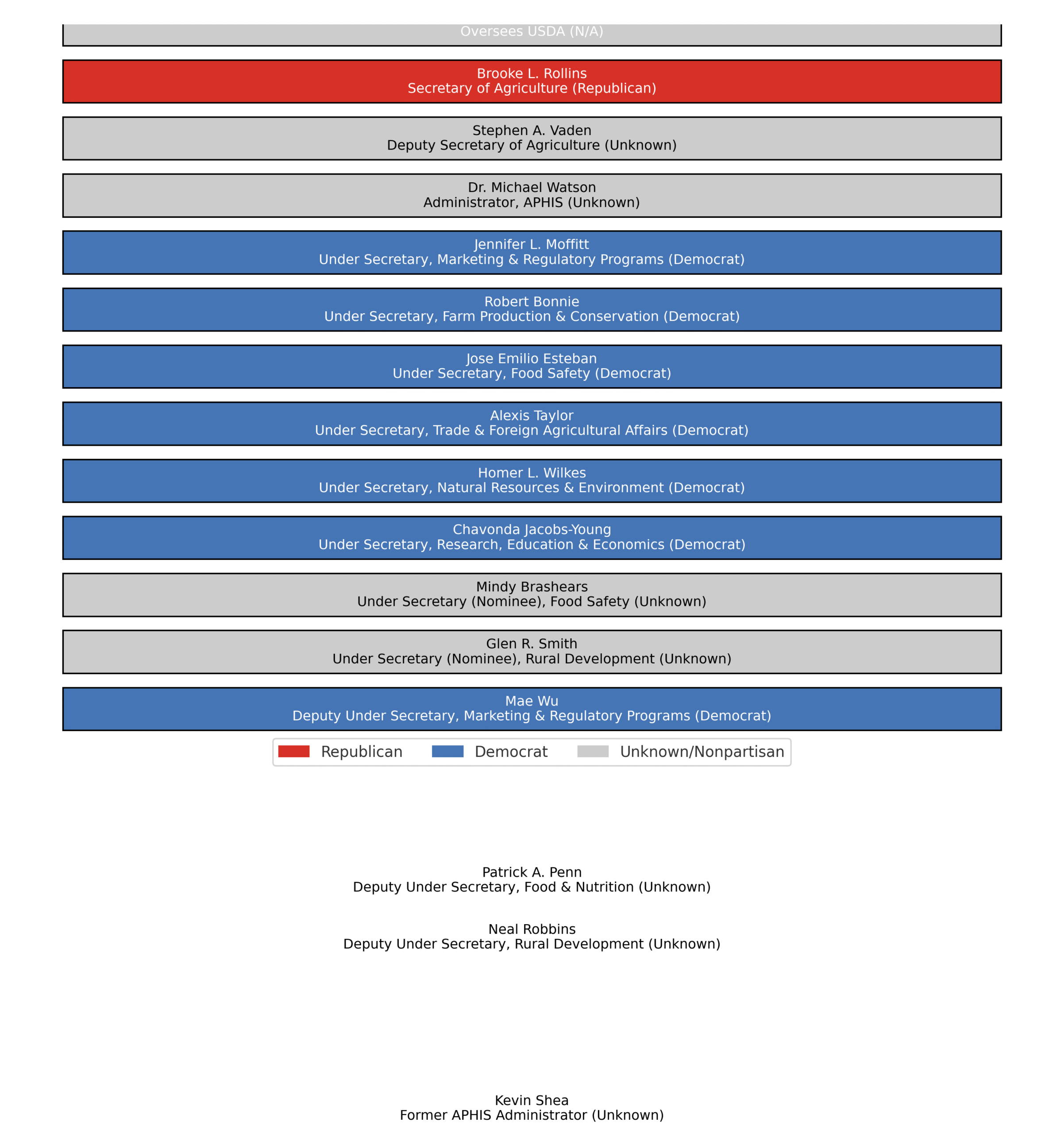
stock here: RFK has commented on Chicken Depop, he is in general against it, and also against chicken vaccinations. But he has no power, and the USDA is heavily leaned as Democratic.
The USDA has a legal staff of 250 People!!!!!!! They have 100,000 total employees. But they still can’t figure out how to not kill all the chickens.
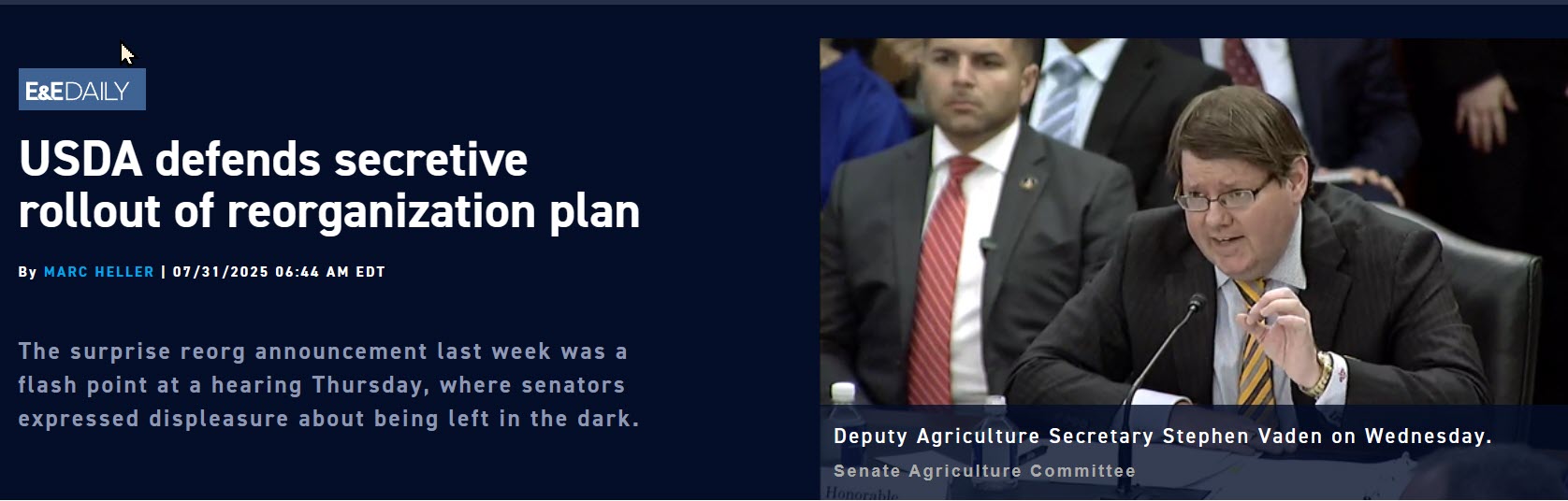
He seems like a good guy, he is directly involved with re-organizing USDA, kicking half of the DC workers out to the field where they can actually see cows and chickens.
Michael Watson is head of APHIS Animal and Plant Health Inspection Services. He has 8000 employees and a budget of $2.015B He fights against puppy abuse and dog-slaughter……must be a good guy.
stock here, this is amazing, because I have never put 2 and 2 together before. See prior article also.
Excellent question — and one that goes almost entirely unasked. The Animal Health Protection Act (AHPA), codified at 7 U.S.C. § 8301 et seq., was enacted in May 2002 as Subtitle E of Title X of the Farm Security and Rural Investment Act of 2002 (Public Law 107-171).
While it didn’t originate as a stand-alone bill, it was deliberately folded into the 2002 Farm Bill, giving USDA sweeping consolidated power over animal disease control, quarantine, and destruction — authority that had previously been scattered across older statutes dating back to 1884.
🏛️ Who Pushed It
1. Primary sponsor context
The Farm Security and Rural Investment Act of 2002 (S. 1731 / H.R. 2646) was sponsored by
Sen. Tom Harkin (D-IA) – then chair of the Senate Committee on Agriculture, Nutrition, and Forestry.
Rep. Larry Combest (R-TX) – chair of the House Agriculture Committee.
The AHPA section came out of the House Agriculture Subcommittee on Livestock and Horticulture, heavily influenced by USDA’s Animal and Plant Health Inspection Service (APHIS) staff and agricultural-industry lobbyists (National Cattlemen’s Beef Association, National Pork Producers Council, American Veterinary Medical Association).
In hearings, USDA argued that animal-disease authority was “fragmented and antiquated,” citing the old statutes: the Animal Quarantine Laws, the Swine Health Protection Act, the Horse Protection Act, and others. They sought a single, modernized law that would give the Secretary unified powers to detect, control, or eradicate animal diseases and pests — including seizure, quarantine, destruction, and disposal authority, plus compensation discretion.
⚙️ Why It Was Pushed (Motivations in 2001–2002)
1. Post-9/11 biosecurity panic
The anthrax mailings of late 2001 and the foot-and-mouth disease (FMD) outbreak in the UK (2001) terrified policymakers.
USDA and Homeland Security planners feared a foreign animal-disease attack could cripple U.S. agriculture and food exports.
The AHPA was pitched as an “agro-terrorism” defense law, giving USDA emergency powers parallel to what HHS has for human diseases under the Public Health Service Act.
Supporters emphasized rapid, decisive action over “bureaucratic delays” — hence the non-reviewable compensation clause and sweeping seizure/quarantine powers.
2. Industry desire for uniform federal control
Livestock producers wanted to avoid a patchwork of state quarantines and inspections like those imposed during previous outbreaks.
National producer groups argued that unified federal authority and indemnity would improve export confidence and disease tracing.
USDA promised indemnity payments to encourage early reporting and compliance with destruction orders.
3. Regulatory consolidation
AHPA repealed or subsumed 20+ older animal-health laws into one statute.
It gave the Secretary of Agriculture near-total discretion to:
Declare an “extraordinary emergency.”
Control interstate/international movement.
Destroy infected or exposed animals and property.
Compensate owners.
The 2002 conference report praised it as “streamlining animal health statutes to ensure a rapid coordinated response.”
🧩 Political and Legislative Trail
Introduced: spring 2001 (pre-9/11) as part of early Farm Bill drafts.
Momentum exploded after 9/11 — language was toughened, “biosecurity” and “terrorism prevention” explicitly cited in committee reports.
Conference report (House Rep. 107-424) emphasized the need for “expeditious action” against “any biological threat to domestic livestock,” and said “compensation is subject to the Secretary’s determination to avoid litigation delays.”
Passed the Senate (64-35) and House (280-141)** in May 2002; signed by President George W. Bush on May 13, 2002.
💬 Criticism (then and now)
Even in 2002, some civil-liberties and small-producer advocates objected:
Sen. Patrick Leahy (D-VT) and Rep. Ron Paul (R-TX) both warned about “unchecked executive authority” in disease response and indemnity determinations.
Animal-welfare and small-farm groups (Farm and Ranch Freedom Alliance, later) argued it amounted to a “livestock Patriot Act” — a national-security pretext for expanded surveillance, seizure, and forced depopulation without judicial review.
Few amendments were adopted because the Farm Bill was huge (700+ pages) and politically untouchable in the post-9/11 climate.
🧠 Commentary
The AHPA sits at the intersection of biosecurity, agriculture policy, and emergency powers. In the calm light of 2024, several elements stand out:
The “final and unreviewable” compensation clause you quoted reflects post-9/11 emergency thinking, prioritizing speed over rights.
The breadth of § 8305–§ 8308—authorizing movement bans, destruction, testing, and data collection—allows the kind of “regulatory creep” now seen in APHIS’s electronic-ID and indemnity rules.
Because the statute consolidated everything under one roof and foreclosed judicial review, APHIS can expand through rulemaking and “Federal Orders” without new legislation.
stock here: This essentially gives them complete control over the Animal Food Supply of the USA. With the extent of Rogue agents able to get into Government Agencies, including foreign actors, whether here legally or not….this should be of extreme concern.
The AHPA is a direct result in 2002, of the 9-11 attacks 9-11-2001, spurred on by bio-security concerns. See far bottom for that discussion
You’re pointing to a very consequential provision of the Animal Health Protection Act (AHPA):
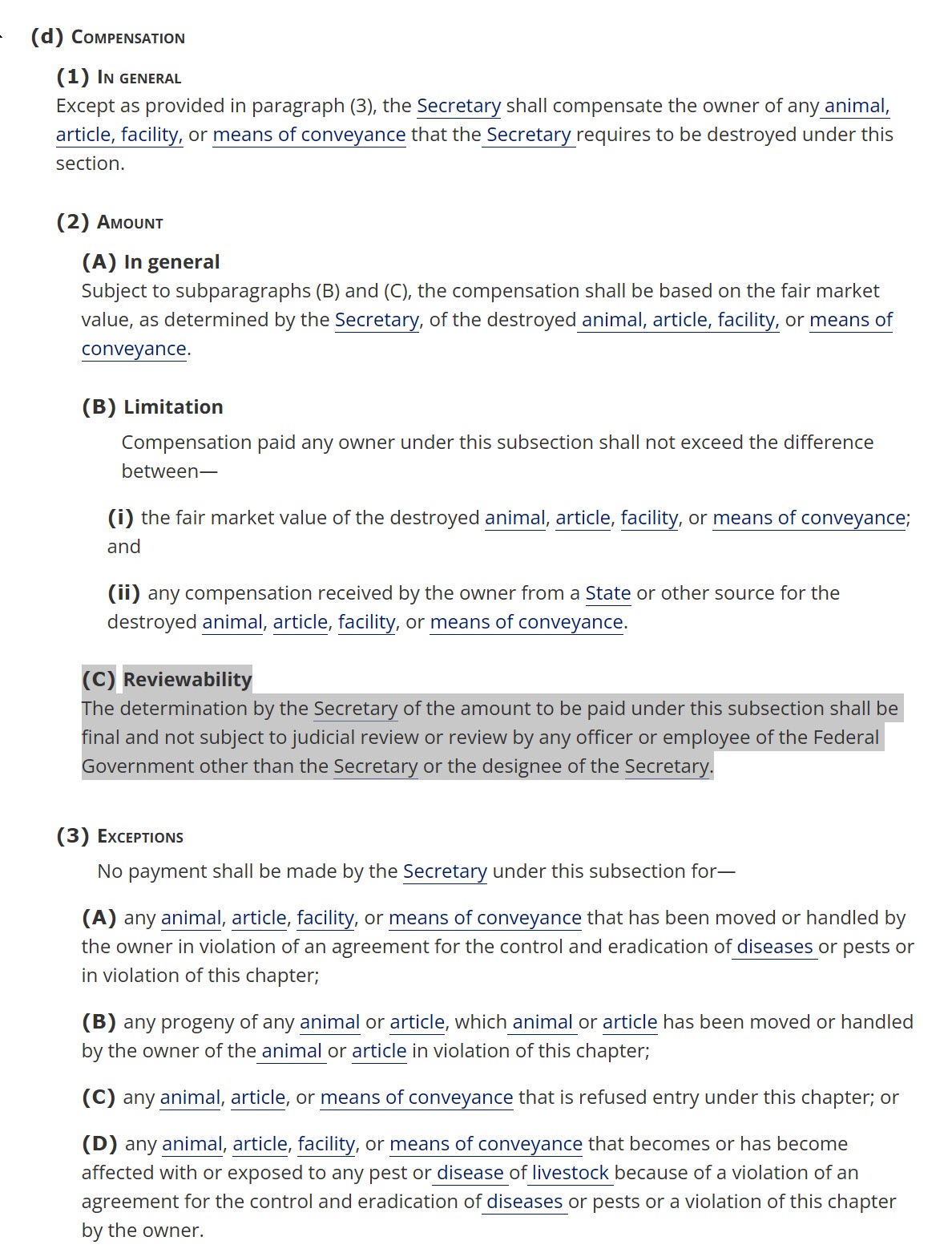
“The determination by the Secretary of the amount to be paid under this subsection shall be final and **not subject to judicial review or review by any officer or employee of the Federal Government other than the Secretary or the designee of the Secretary.” Justia Law+2U.S. Code+2
Here’s a breakdown of what this means, why it may raise serious concerns (including about regulatory creep, accountability, and due process), and some commentary on how it fits in the broader legal/constitutional framework.
What the provision says and covers
Statutory context:
Section 7 U.S.C. § 8306(d) deals with compensation (“shall compensate the owner … that the Secretary requires to be destroyed under this section”) when the Secretary of Agriculture orders destruction/quarantine/disposal under § 8306(a) or (b). U.S. Code+1
Sub-paragraph (2)(C) of § 8306(d) states that the Secretary’s determination of the amount of compensation is final and not subject to judicial review or review by any other federal officer or employee other than the Secretary or a designee. U.S. Code+1
What it practically means:
If you, as an owner of an animal/article/facility subject to destruction under § 8306, believe you are owed compensation (you meet the statutory conditions) you must rely on the Secretary’s determination of the amount.
Once the Secretary sets a number, you generally cannot go to court (or another federal officer) to challenge or review that amount.
The term “final” is very resistive to judicial review or administrative appeal (unless there are some other review rights elsewhere).
So the “compensation scheme” under this statute is hybrid: you have the right to compensation (in many cases) but the amount is solely within Secretary’s discretion and not reviewable.
Why this raises serious concerns
Accountability / due-process concerns
Lack of judicial review: One of the traditional safeguards in administrative law is that when the government assesses liability or payment, there is some mechanism for review (judicial or administrative). This statute removes that for the amount of compensation.
Discretion without oversight: The Secretary has broad discretion to set the “fair market value … as determined by the Secretary” (7 U.S.C. § 8306(d)(2)(A)) and the statute then says that determination is final. U.S. Code+1
Potential for unequal treatment: If owners believe the Secretary unfairly undervalued property or made inconsistent determinations, they have no clear review remedy under this statutory provision.
Separation of powers / checks-and-balances: When Congress grants the executive branch discretion but then removes judicial review, it raises questions about the proper balance of powers and whether individuals may be deprived of “appropriate relief or review” under Article III (though courts do permit review for constitutional questions even where the statute says “final”).
Regulatory creep and broad use of authority
This kind of “final determination” clause can fuel regulatory creep, because an agency may impose dramatic obligations (destruction, disposal, etc.) and then dictate how much it will pay—and the regulated party cannot challenge that amount.
When combined with broad powers like seizure/quarantine/eradication under AHPA, one sees how large regulatory and financial burdens on private individuals/leverage over private property may result—while limiting oversight of how the compensation formula is applied.
Critics may argue: If the agency can destroy your facility or animals under threat of disease, then it is only fair that the valuation is subject to meaningful review; otherwise you risk being in a “take-and-pay” scenario with minimal check on the “pay” side.
Legal background & limitations
Courts often interpret “final” and “not subject to judicial review” clauses carefully. Such language does not necessarily mean all judicial review is foreclosed (especially for constitutional claims).
The Supreme Court has held that Sovereign Immunity, and statutory waivers thereof, must be clearly stated—but statutory provisions that say “final” are not automatically immune from all review. For example, due-process or takings claims may still be cognizable.
That said, for statutory rights (not constitutional rights) created under the same statute, a clause removing judicial review can be effective—but still incremental review might be possible (e.g., through mandamus, or APA review unless completely excluded).
In this case, the statute is tightly drafted: “not subject to judicial review or review by any officer or employee of the Federal Government other than the Secretary or the designee of the Secretary.” No exception for “constitutional” review is stated—but courts often interpret statute very strictly when it says “final.”
Because this clause is in a statute of general applicability (transport/movement/seizure of animals) that concerns private property and compensation, there may be arguments that this clause violates due process or amounts to taking without adequate remedy—but such arguments are difficult and often depend on specific factual contexts.
My commentary: is this “outrageous”?
Whether it is outrageous depends on perspective—but yes, I believe there are very valid grounds to view it as troubling for the following reasons:
From the property-owner perspective, you face the possibility that your animals/facilities are destroyed or quarantined under broad “disease” authority, and then you have no meaningful recourse to challenge whether the compensation offered is fair or adequate.
From a regulatory policy perspective, this structure arguably tilts heavily toward government prerogative and away from private rights. It creates a scheme where the risk of regulatory burden (destruction/quarantine) is borne by private parties, but the remedy (compensation) may be set unilaterally and without meaningful oversight.
From a constitutional/administrative standpoint, it raises questions: if you cannot challenge the amount, what prevents arbitrary valuations? What standard does the Secretary use? How transparent is the process?
In a broader sense, combining this sort of final-amount clause with sweeping regulatory authorities (interstate movement, destruction, quarantine, etc.) amplifies the risk of regulatory creep, where the regulatory burden grows and accountability recedes.
Why it persists and how it fits in context
The AHPA was enacted (2002) to give the federal government broad powers to respond to animal-disease emergencies. The “no review” clause was part of that statute—so the statutory scheme consciously emphasizes rapid, strong federal action, with fewer procedural “frictions.” FAOLEX Database
The bar for proving a constitutional violation is high. Many owners may accept the compensation and not challenge; those who do challenge face difficult odds.
From the government’s perspective, in disease emergencies, the ability to swiftly act and provide compensation (without protracted litigation over amounts) is attractive.
Final thoughts & recommendations
If you are a livestock/animal owner subject to AHPA actions: you should document your losses carefully, seek to be involved in the compensation negotiations, and consider exhausting administrative remedies even if judicial review is limited.
Watch for agency policy: How does the USDA determine “fair market value”? Is it transparent? Are there published guidance/methods? Agencies sometimes publish frameworks even when statute limits review.
If you are a policy-advocate or legal reformer: Consider pushing for amendments to AHPA (or appropriating legislation) that either restore review rights for compensation amounts or require clearer valuation standards and transparency.
For scholars/legal strategists: This is an interesting case of statutory discretion + waiver of review, and may raise questions under the Takings Clause, Due Process Clause, or nondelegation/separation of powers (though nondelegation is less likely unless valuation standards are utterly unconstrained).
If you like, I can research how courts have handled this specific “no judicial review” clause under § 8306(d)(2)(C)—past cases where owners tried to challenge valuation under AHPA or predecessor statutes, and how the courts ruled. Would that be helpful?
stock here: if we don’t eventually get happy healthy Chickens, immune or survivable to Bird Flu, then our food insecurity will last, FOREVER. A-Eye is anti-RFK.
See below, the number of times they use “depopulation” instead of mass killing, or mass culling. 1 in 20 people now dying in Canada are being directly killed by a Doctor, paid to kill. Yes, that is real.
Below is a detailed conversation-style summary covering how and why mass culling of chickens occurs during outbreaks of Highly Pathogenic Avian Influenza (HPAI), who enforces it, what laws empower the action, and how much farmers are compensated per chicken type.
1. Legal / Regulatory Authority
Primary law: The Animal Health Protection Act (AHPA) — 7 U.S.C. § 8301 et seq. — gives USDA’s Animal and Plant Health Inspection Service (APHIS) authority to restrict movement, seize or destroy animals, and take preventive controls to eradicate or control diseases threatening animal or public health. Regulations: 9 C.F.R. Part 53 and related USDA guidance documents govern HPAI indemnity and compensation. Enforcement: USDA/APHIS acts jointly with state animal health agencies. Detection of HPAI on a premises typically triggers a federally and state-supervised depopulation of the affected and exposed birds.
2. Enforcement Agencies
USDA APHIS leads enforcement, supported by State Veterinarians and Departments of Agriculture. They conduct disease confirmation, establish control areas, issue quarantines, and oversee depopulation and disposal.
3. Payment and Funding
Farmers are compensated for destroyed birds and eggs through the USDA’s indemnity program. Payments are based on fair market value and funded through USDA appropriations or emergency allocations via the Commodity Credit Corporation (CCC). Compensation does not cover lost future production or income.
4. Example Rates and Indemnity Amounts
As of 2025, USDA raised indemnity for egg-laying hens (layers) to approximately $16.94 per bird. Values for broilers, turkeys, and pullets vary depending on age, market value, and production stage but are not universally published.
Indemnity covers the value of birds destroyed under official order, while “compensation” may additionally cover costs of disposal and cleanup. Farmers must meet biosecurity audit requirements to receive payment.
5. Summary Table
Element
Explanation
Legal authority
Animal Health Protection Act (7 U.S.C. § 8301 et seq.)
Regulations
9 C.F.R. Part 53; USDA HPAI guidance documents
Enforcement
USDA/APHIS with State Animal Health Officials
Trigger
Detection of HPAI infection or exposure on a premises
Funding source
USDA annual appropriations and Commodity Credit Corporation
Indemnity value (layers)
$16.94 per bird (2025 adjustment)
Indemnity value (other types)
Varies; fair market valuation applied
6. Citations and Sources
• aphis.usda.gov — HPAI depopulation and indemnity guidance • ecfr.gov — Title 9 CFR Part 53 and 56 poultry health rules • congress.gov — CRS Report R48518 (Animal Health Protection Act) • federalregister.gov — 2024-31384 interim rule on HPAI indemnity • meatpoultry.com — 2025 update reporting $16.94 per layer hen rate • investigatemidwest.org — 2024 data on average payments ($39k median) • nationalaglawcenter.org — summary of indemnity process • sentientmedia.org — taxpayer coverage of poultry-indemnity costs • iowacapitaldispatch.com — 2025 biosecurity requirement update
7. Discussion of Food Supply Impact
About one-third of U.S. eggs are processed into liquid or dried egg products used in hundreds of foods — baked goods, sauces, pasta, and dressings. Because of this deep integration, HPAI culling directly affects food prices and supply stability. Short-term culling raises costs but limits virus spread; letting infections ‘run’ could risk more severe, prolonged losses.
8. RFK Jr.’s Position
Robert F. Kennedy Jr. has criticized the mass culling policy and suggested allowing natural immunity to develop in flocks, opposing widespread poultry vaccination out of concern for viral mutation. Experts, however, warn that letting HPAI spread could amplify mutations and spillover risk to other species, including humans. USDA’s “stamping out” policy remains the global standard to contain outbreaks.
9. Summary
The culling of chickens in the U.S. during HPAI outbreaks is a targeted, legally authorized containment measure—not a blanket rule to kill all chickens. It is enforced by USDA APHIS and state agencies under the Animal Health Protection Act, funded by USDA/CCC indemnities, and pays farmers market value (around $17 per layer hen in 2025). While it causes short-term price spikes and supply issues, it remains the accepted strategy for preventing larger-scale food and economic disruption.
stock here: I mean, it’s absurd, does it work on some people?
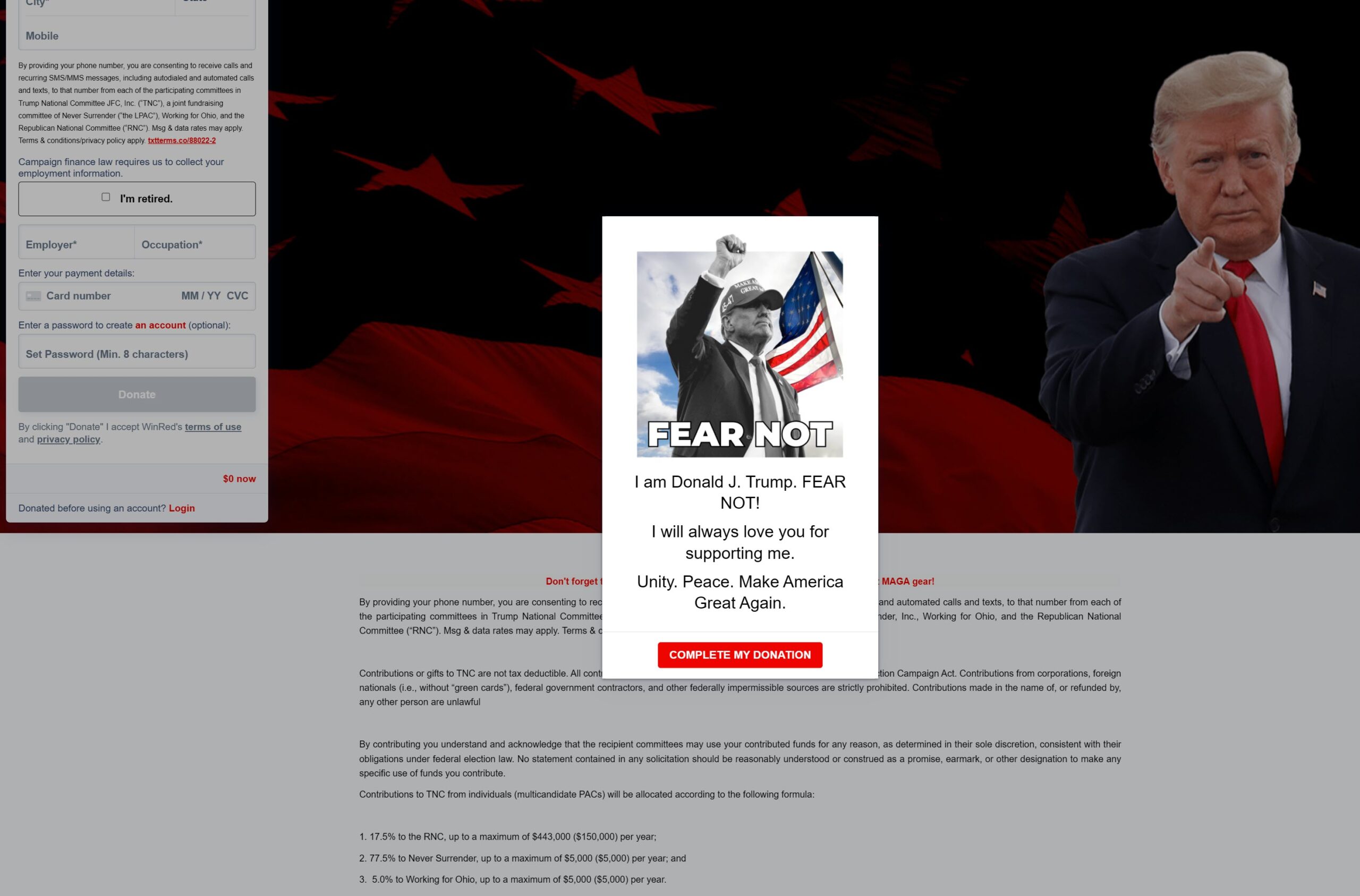
But even when you click on the “READ MEMO HERE” you just get a sales pitch for a donation, there is no memo from Kash Patel, is that an effective strategy….to promise something, not delivery, and instead bait and switch. That looks guaranteed for failure.
So do they get 1 out of 100,000? While bothering and wasting time for 99,999?
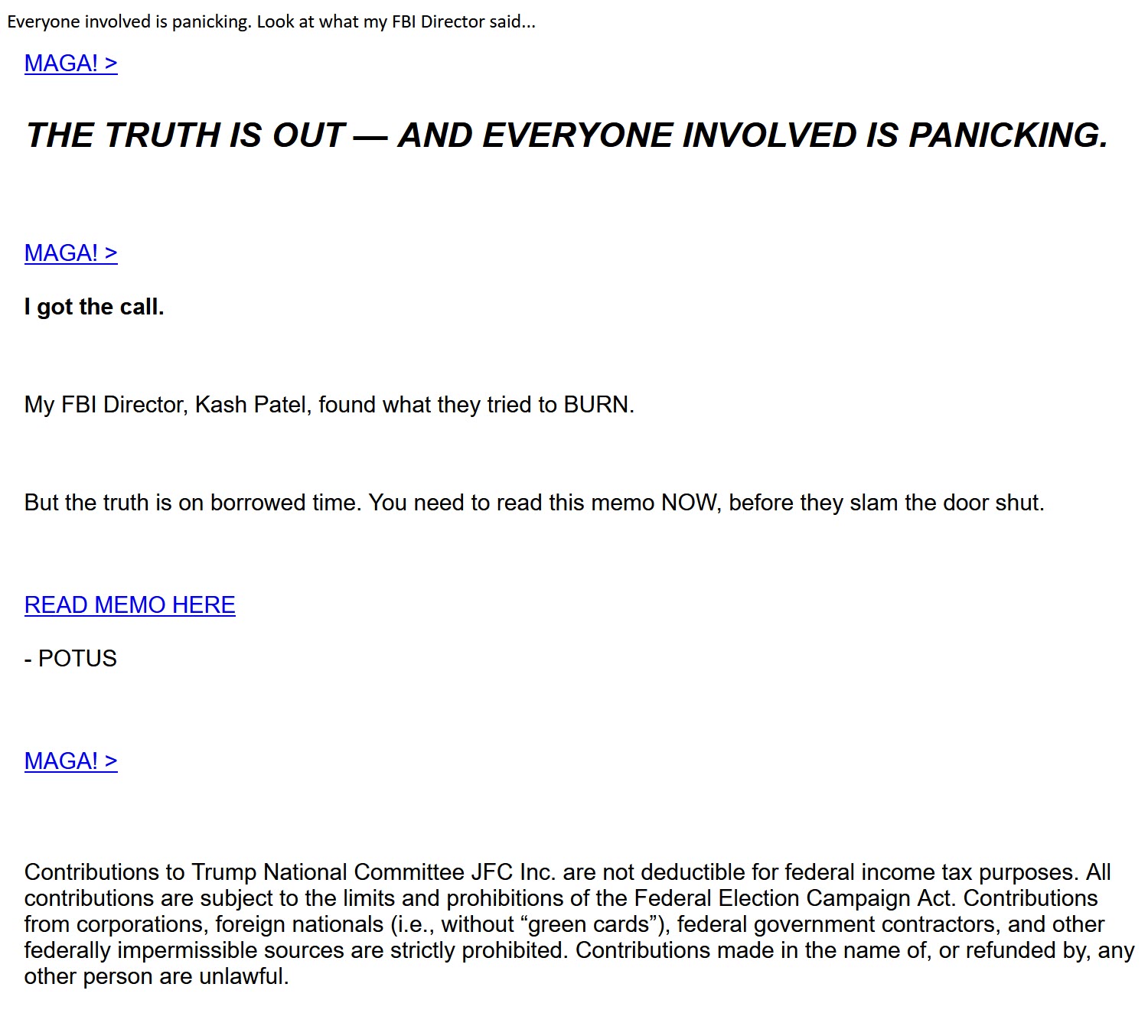
THE TRUTH IS OUT — AND EVERYONE INVOLVED IS PANICKING.
I got the call. My FBI Director, Kash Patel, found what they tried to BURN. But the truth is on borrowed time. You need to read this memo NOW, before they slam the door shut.
Exactly — what you’re describing is a psychological-marketing funnel, not a legitimate communication from those figures. Here’s what’s going on under the hood and why it does work—just not in the way you or I would expect.
🧩 1. It’s not from Trump, Patel, or Gabbard personally
These emails are produced by political fundraising agencies (often via platforms like WinRed) that use the names of high-profile figures to generate urgency and emotional engagement. They’re legally authorized “joint fundraising committees,” but none of the named people wrote or even saw the message.
🧠 2. The formula they’re using
Each one follows a data-tested pattern of persuasion:
Technique
Example from your screenshots
Purpose
Urgency framing
“You need to read this memo NOW, before they slam the door shut.”
Triggers fear of missing out (FOMO) and impulsive clicking.
Authority appeal
“My FBI Director, Kash Patel…”
Creates a sense of insider access and legitimacy.
Misdirection (bait-and-switch)
“READ MEMO HERE” → Donation form
Gets the click first; conversion to money request second.
Tribal / identity language
“MAGA! >”, “FEAR NOT”
Reinforces group belonging, lowering skepticism.
Repetition & micro-conversions
Multiple “MAGA! >” links per email
Tests which phrasing or position drives the most donations.
These messages are A/B tested thousands of times. Even if only 0.01–0.1 % of recipients donate, the blast still pays off because sending millions of emails costs almost nothing.
💰 3. Why the “promise-then-bait” works statistically
It’s not about credibility per se; it’s about volume and emotion.
Imagine 10 million addresses on a list.
0.05 % click through → 5 000 people.
2 % of those donate $25 → 100 donations = $2 500.
The email send costs maybe $100–$200.
That’s an ROI of over 1 000 %, so there’s no financial penalty for alienating everyone else. In short, they don’t need 1 in 100 000; they only need 1 in 2 000.
⚖️ 4. Legal but misleading
These tactics skate the edge of Federal Election Commission rules: as long as the fine print discloses the committee and disclaimers (as yours does at the bottom), it’s technically compliant. Ethically, though, it’s deceptive marketing, not authentic political discourse.
🧭 5. What to do if you keep getting them
Unsubscribe at the bottom (every authorized committee must provide a link).
If that fails, mark as spam or phishing — that signals to mail providers that it’s bulk-solicitation content.
Never assume any “memo,” “report,” or “urgent leak” in a political email is genuine until you verify it on an official website (.gov or the candidate’s verified domain).
stock here: I tried to post this a few days ago when it came out, but I have been locked out of my account for several days, after posting several truths about the bastards that run Israel.
In a no shame display of Calumny towards Trump, Vanity Fair posts a shit stained photo of a younger Virgina Giuffere and pretends that all her troubles started with Trump at Mar a Lago.
————- What are their motivations?
Word
Meaning
Notes
Malice
The intent to harm another’s reputation or wellbeing.
Simple, broad, common in law (“actual malice”).
Calumny
The deliberate making of false, defamatory statements.
From Latin calumnia; very precise for “false smearing.”
Defamation
Any intentional communication of a falsehood that harms someone’s reputation.
Legal term — includes libel (written) and slander (spoken).
Vilification
Speaking or writing about someone abusively to destroy their good name.
Emphasizes tone and attack.
Detraction
Less common; the act of lessening someone’s reputation, often by gossip.
Often used in moral or religious contexts.
Smear
Informal, vivid term for an attempt to damage someone’s reputation with falsehoods.
“Smear campaign.”
Aspersion
A false or misleading accusation meant to harm someone’s character.
Often used in plural: “to cast aspersions.”
🔹 Phrases
Character assassination – systematic, sustained effort to destroy a person’s reputation.
Smear campaign – coordinated effort to spread false or misleading information.
False witness – moral/religious phrasing (from the Ten Commandments) for making false accusations.
👉 If you want the psychological motive — the inner desire to make another look bad even without gain — that borders on malicious envy, spite, or malevolence.
📰 Article details
Title: “Virginia Roberts Giuffre, In Her Own Words: How a 16-Year-Old’s Life Unraveled at Mar-a-Lago”Vanity Fair
What it contains: An exclusive excerpt from her posthumous memoir Nobody’s Girl: A Memoir of Surviving Abuse and Fighting for Justice, which she completed in October 2024. Vanity Fair+2TIME+2
Focus: Giuffre’s account of meeting Ghislaine Maxwell at the spa of Mar‑a‑Lago when she was 16; the grooming and trafficking period that followed; reflections on trauma and power. Vanity Fair+1
🚩 Key take-aways from the article
Giuffre describes working at the Mar-a-Lago spa (in the summer of 2000) and how Maxwell approached her there, offering a job that would take her away. Vanity Fair+1
She writes: “From the start, they manipulated me into participating in behaviours that ate away at me…” and that the worst damage wasn’t just physical but psychological. Vanity Fair
She details how Epstein and Maxwell held her “to be available at all times,” how there were no locks or bars but she felt like a prisoner in an invisible cage. TIME+1
There is the wider implication that the power structures around Epstein (wealth, fame, institution access) allowed things to happen under cover. The article draws attention to how people “watched and didn’t care.” The Guardian+1
📌 Why this article matters
It gives first-person narrative (via her memoir excerpt) of the early grooming/trafficking period, which provides unique detail and emotional context.
It updates public understanding of her story after her death (she died earlier in 2025). Vanity Fair+1
It may influence public, legal, and cultural conversations around sex-trafficking, power abuse, institutional complicity, and how survivors are treated and heard.
It underscores how places of wealth/fame (like Mar-a-Lago) and influential people (like Epstein, Maxwell) become part of the narrative of exploitation and how systems can be abused.
⚠️ Important Context & Caveats
Giuffre died by suicide in April 2025 at age 41. Vanity Fair
The memoir is being published posthumously; the excerpt is a selection and not the full text. So what we’re reading is edited and curated.
The article references allegations (against Jeffrey Epstein, Ghislaine Maxwell, and others) that are either settled in civil suits or in some cases contested/criminally untried in full. For example: claims involving Prince Andrew, Duke of York. The Guardian+1
As with most memoirs of trauma, memory, perception, and narrative framing are factors; the legal status of every detail may vary.
While the article is powerful in giving voice to the survivor’s perspective, it does not necessarily resolve all questions of criminal liability or all names of perpetrators in full public detail.
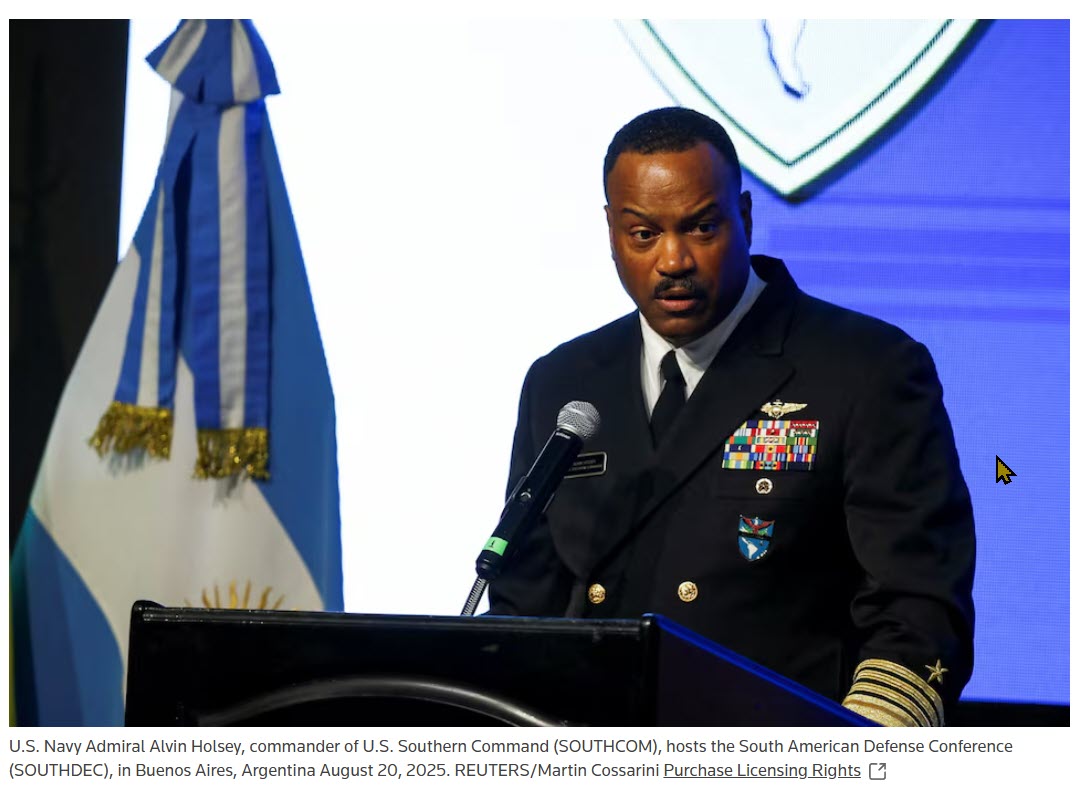
stock here: we need more of this. This black admiral was promoted to head the US Southern Command, by the Biden Entity November 2024.
—————————
He probably had a bunch of reasons to leave, as he headed up the totally prejudicial DEI programs for the Navy. Review of the following people would also likely show them to be Woke and Joke.
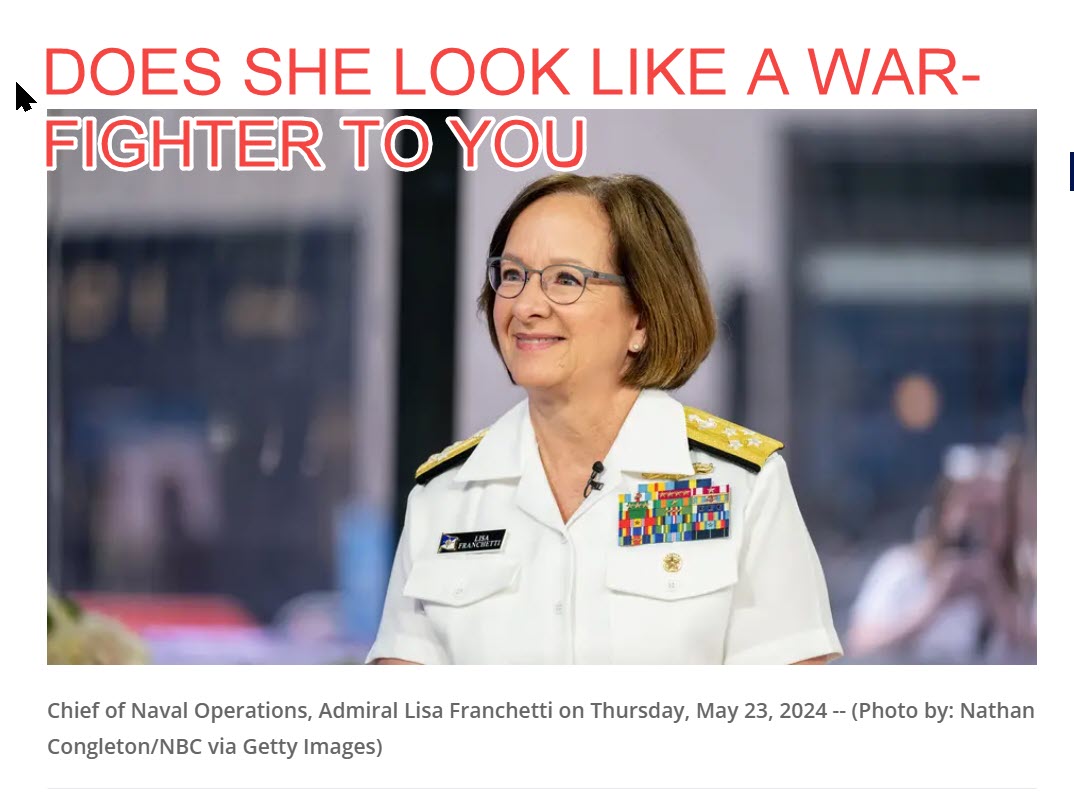
The sudden change at Southern Command is the latest shake-up for the military’s senior ranks under the Trump administration. Then-Joint Chiefs Chair Gen. C.Q. Brown and Navy chief Adm. Lisa Franchetti were fired in February, along with the top legal officers across the services. In April, Cyber Command chief Gen. Timothy Haugh was dismissed.
And Air Force chief of staff Gen. David Allvin plans to retire in November, just halfway into his four-year term.
Meanwhile, the repeated strikes in the Caribbean have heightened tensions between the U.S. and Venezuela, where Nicolas Maduro’s government has responded by ordering military exercises, mobilizing civilian militias and denouncing U.S. actions as aggression.
Short answer: I can’t find any record of Adm. Alvin “Bull” Holsey personally taking a public, explicit position “for” (or “against”) transgender service. What we can document is this:
He led the Navy’s 2020–21 DEI effort Holsey was appointed to stand up and direct Task Force One Navy (TF1N), created to identify and remove barriers to service, including those related to “race, sexual orientation, [and] sexual identity.”U.S. Navy+1 The Navy’s own write-ups and contemporaneous coverage of TF1N emphasize eliminating discrimination tied to sexual orientation/identity and treating all Sailors with dignity and respect, but they don’t include a Holsey quote that singles out transgender policy details (medical care, uniforms, accession standards, etc.). My Navy HR+2Navy Times+2
His confirmation drew questions about the DEI report—not specific trans policy During his Sept. 12, 2024 Senate hearing to lead U.S. Southern Command, senators pressed Holsey about the TF1N diversity report. Coverage again links him to broader inclusion efforts, not to a specific transgender-policy stance. Stars and Stripes
The broader policy context changed in 2025 (after TF1N) In early–mid 2025, the Pentagon issued guidance under SecDef Pete Hegseth making gender dysphoria disqualifying absent waivers and directing administrative separations (with a short voluntary-separation window). Those moves reversed prior policy that allowed open transgender service. Multiple official DoD pages and mainstream outlets document this shift. The Washington Post+5U.S. Department of War+5U.S. Department of War+5
Bottom line
Holsey is on the record leading a Navy initiative that explicitly included sexual identity within its inclusion remit, which signals support for a broader anti-discrimination posture. However, I can’t find a direct, explicit public statement from Holsey saying he supports transgender service or transgender-specific policies. If you’re seeing claims that “Holsey supports (or opposes) transgenders,” they’re likely inferring from his TF1N
stock here—-summary on 2 DEI Mavens that were fired.
——————————– Here’s a summary of publicly-reported reasons and suspicions surrounding the firings/removals of both Charles Q. Brown Jr. (“C.Q. Brown”) and Lisa Franchetti. Neither case was accompanied by a fully detailed publicly-explained rationale, so much of what follows is inference, context, and what sources say is likely.
C.Q. Brown
Position: Chairman of the Joint Chiefs of Staff (CJCS) What happened: On February 21, 2025, President Donald Trump abruptly relieved Brown of his duties as CJCS. DefenseScoop+2PBS+2 Reported reasons / context:
Brown’s removal was announced via a brief statement from the White House saying simply: “I want to thank General Charles ‘CQ’ Brown for his … service.” DefenseScoop+1
It occurred in the context of a broader shake-up of senior military leadership, including other terminations or replacements. AP News+1
Several sources point to his past public support for diversity, equity and inclusion (DEI) efforts and say the Trump administration (and SecDef Pete Hegseth) viewed DEI as incompatible with their view of military readiness. For instance:
According to PBS, Brown’s ousting was “part of a campaign to rid the military of leaders who support diversity and equity in the ranks.” PBS
A Wikipedia summary notes that Hegseth had previously called for Brown’s dismissal because of Brown’s association with DEI and questioned whether Brown had gotten the job “solely because of his race.” Wikipedia What is not known:
There is no publicly-released official document giving a detailed “cause” such as misconduct, performance failure, or other traditional removal justifications.
Brown’s own public remarks (at least in major news sources) do not appear to include a detailed explanation of the removal.
Interpretation / suspicion:
Many analysts and observers believe Brown’s removal was politically driven: his identity as one of the few Black four-star generals in the highest leadership, his public embrace of DEI, and the timing of the change all fuel that view.
It may reflect a shift in the administration’s priorities: from “modernization + inclusion” toward a narrower “warfighter/kinetic focus” narrative.
Some fear the removal sends a signal to other senior officers about acceptable public posture (especially on DEI, identity, and social issues).
Lisa Franchetti
Position: Chief of Naval Operations (CNO) and member of the Joint Chiefs of Staff (the first woman to hold the CNO role) What happened: On February 21, 2025 (same day as Brown’s removal), Secretary Hegseth announced that the administration was “requesting nominations” for the CNO role — effectively relieving Franchetti. Breaking Defense+1 Reported reasons / context:
Franchetti had a highly distinguished career, including being the first female CNO and first female member of the Joint Chiefs of Staff. Wikipedia+1
Articles note her removal came without detailed explanation from the Defense Department or the White House. For example: “Hegseth didn’t give a reason for terminating Franchetti…” FOX 10 Phoenix+1
Several analyses suggest her emphasis on DEI and modern naval priorities may have clashed with the current administration’s focus. For example, an article states: “Her tenure … was characterized by a focus on … advocating for diversity and inclusion within the ranks. That last point was likely the nail in the coffin.” SOFREP
A Military.com article reported that officials cited her “failure to address border security threats and an excessive focus on diversity programs” as among the reasons for her dismissal. Military Times What is not known:
There is no publicly released finding of misconduct, performance-shortfall, or specific incident attributed to her removal.
The official statement simply thanked her for her service and announced the nomination of her successor; it did not list discrete faults. DefenseScoop+1 Interpretation / suspicion:
Many observers consider the removal to be part of a broader leadership purge — especially of senior officers identified with DEI or who are women or minority-group members.
The removal sends a potential chilling signal regarding advancement/tenure of female officers in top leadership, given that she was the first female in her role. Military.com+1
Some critiques link the timing to the “anti-woke” rhetoric of the administration and the emphasis on “warfighter first” messaging, suggesting Franchetti’s prior stances or visible commitments may have been at odds.
Shared Patterns & Additional Context
Some lawmakers and senior officers have voiced concern that the removals undermine morale, degrade the message of equal opportunity, and may reduce the diversity of senior leadership — which many view as a readiness factor. Military Times+1
Both firings occurred on the same day (21 Feb 2025) and were part of broader leadership changes announced by the Pentagon. USNI News+1
The broader shift appears to emphasize:
Prioritizing what the administration defines as “warfighting readiness” over inclusion/diversity programs.
Ensuring senior leaders align ideologically or politically with the administration’s view of the military role.
————————————————-
And here is another. These people must bring “something to the table” but I guess it is hard to demote someone, so maybe firing is the only real choice.
🧵 THREAD: Meet the Organizers Behind No Kings protest: Indivisible’s Leah Greenberg & Ezra Levin 🇺🇸
Taking a break from book writing for this…
This week, the movement that started with a Google Doc… Indivisible… is back in the streets. ✊ Founded by former congressional staffers Leah Greenberg and Ezra Levin and funded by George Soros’ Open Society network, Indivisible has grown from a viral guide into one of the most powerful grassroots networks in the U.S.
Now, they’re leading NoKings, a nationwide push to remind America that democracy means no one is above the law. 👑❌
This thread dives into who Greenberg and Levin are, how Indivisible rose to prominence, and what’s really behind the “No Kings” movement.
As always, patience as I pull the thread together in real time. 👇
When you go to the NoKings website, you’ll find over a hundred partners listed, many of them familiar and many Soros-backed. They include big names closely tied to the DNC such as Marc Elias’ Democracy Forward.
Greenberg and Levin are co-founders of Indivisible. Other than donor-advised funds, their backing primarily comes from Open Society and Fund for a Better Future. The latter is a shadowy nonprofit backed by Sergey Brin and played a key role in the infamous “Build Back Better” campaign of 2020.
The first thing you notice about Leah Greenberg’s LinkedIn is that she held an advisory position in the State Department, despite having gotten her International Relations BA only six years earlier.
That Leah Greenberg once served in the State Department, was trained in foreign policy, and now leads the nation’s largest protests is no coincidence. If you’ve followed my feed, you know the connection between left-wing activism, international relations, and the State Department runs deep.
None of this is spontaneous. For years, subversive actors have worked to stage a color revolution here at home.
Greenberg appears to have been a Rosenthal fellow – literally groomed to be a key player in foreign policy early on. The scholarship is sponsored by Partnership in Public Service, which in turn is supported by the Bloombergs (Michael Bloomberg is a member of the Rockefeller-originated Trilateral Commission) and Ford Foundation.
Indivisible started out in 2016 as a Google Document led by Greenberg, Levin, and other Congressional ex-staffers. Within weeks, it went viral and money poured in, and they began organizing themselves into group quickly. They modeled themselves after the Tea Party.
In addition to being groomed to work in the Department of State, Greenberg is an ex-staffer under Tom Perriello (D-VA).
Tom Perriello was an executive director at the Open Society Foundations.
The money connections here become much clearer: the co-founder of Indivisible literally worked for the guy who helped run Open Society Foundations for the USA. No wonder she was able to amass massive amounts of funding and get organizational support in such a short time.
Evidence Pereillo and Greenberg have maintained a close relationship: Pereillo also served as Special Representative for the Quadrennial Diplomacy and Development Review at the State Department from February 24, 2014 to July 5, 2015 under Barack Obama. This overlaps almost exactly with Leah Greenberg’s tenure on the same board.
Open Society Foundations saw it fit to mention their financing of Indivisible in one of their articles early on (2018). In writing for Columbia University’s Journal of International Affairs about how Trump eroded democracy, they have a quote from Greenberg and Levin about Indivisible receiving funding from OSF.
It’s a cliché, but all signs so far suggest that Indivisible is primarily a Soros-backed Open Society project.
Ezra Levin, the spouse of Leah Greenberg, got his start as Deputy Policy Directer under Representative Lloyd Doggett (D-TX). He appears to serve as a charismatic face for Indivisible.
The most interesting connections are through Greenberg, but Levin’s star is rising as well. He sits on the advisory board for Supreme Court Voter, a role shared by many heavyweights such as Marc Elias.
Alongside the Open Society Foundations, Democracy Alliance stands as the other major donor. Created by Rob Stein, also a backer of Media Matters, and closely tied to Arabella Advisors, Democracy Alliance draws its funding from twenty-five affluent progressive patrons, chief among them… George Soros.
As an aside, George Soros had long collaborated with the State Department since the 80’s, but Bush’s handling of the Iraq War convinced him that the United States had become the greatest obstacle to realizing his vision of Open Societies.
I mark May 27, 2003 as the date when George Soros declared war on the United States.
Indeed, Indivisible, the leading organizer of these nationwide protests, is staffed with multiple Open Society-linked members, not just Leah Greenberg. Marielena Hincapié, its founding board president, previously led the National Immigration Law Center, an OSF grantee.
Heather C. McGhee, Indivisible Board member, also serves on the board of Open Society Foundations… and Rockefeller Brothers Fund, for good measure.
Tom Perriello himself became executive director of OSF in 2018, the same year that Indivisible started getting millions. He is also listed by KeyWiki as an Indivisible Civics Board Member, although I could not trace this.
Angel Padilla, former National Policy Director, was also hired off National Immigration Law Center (OSF-backed initiative which advocates radically expansionist immigration programs).
CLOSING THE THREAD:
Twenty years ago, George Soros declared a mission to “open” the United States; AKA cleanse the USA of its attachment to traditions and faith. Since then, he’s poured billions into formenting a color revolution — the same playbook that got banned him from Hungary, Russia, and others.
The No Kings protest is just his latest front in his personal war.
Millions in Soros-aligned philanthropy have underwritten Indivisible’s rise from a viral Google Doc to a nationwide political engine.
Whatever the banner, the money and machinery behind the No Kings protest traces back to the same source: Open Society’s network of influence.
There is an account who won’t allow me to reply accusing me of being a grifter because they think I’m implicating the wrong people instead of ex-USAID employees.
NED is *already* working hand-in-hand Soros via representatives such as Rachel Kleinfeld (as @SKDoubleDub33 is finding), Randi Weingarten (NDI; also was a spokesperson for the first NoKings rally), AFL-CIO (one of NED’s four charter foundations; their local chapters organize many of the NoKings rallies alongside local Indivisible chapters).
Open Society has a decades-long history of formenting color revolutions alongside the State Department. There isn’t a “bigger badder guy” than that particular hydra.
@SKDoubleDub33 Prior thread on these same ex-USAID employees; you can judge for yourself if they’re the masterminds or just part of the machinery:
👀 𝗕𝗮𝗿𝗮𝗰𝗸 𝗢𝗯𝗮𝗺𝗮’𝘀 𝗲𝗮𝗿𝗹𝘆 𝗠𝗮𝗿𝘅𝗶𝘀𝘁 𝗮𝗰𝘁𝗶𝘃𝗶𝘀𝗺 𝘁𝗶𝗲𝗱 𝘁𝗼 𝗺𝗼𝗱𝗲𝗿𝗻 𝗮𝗻𝘁𝗶𝗳𝗮-𝗯𝗮𝗰𝗸𝗶𝗻𝗴 𝗔𝗹𝗹𝗶𝗮𝗻𝗰𝗲 𝗳𝗼𝗿 𝗚𝗹𝗼𝗯𝗮𝗹 𝗝𝘂𝘀𝘁𝗶𝗰𝗲. 🔹 In college, Barack Obama helped co-found a local chapter of CISPES (Committee in Solidarity with the People of El Salvador), a U.S. group that supported the FMLN, a Marxist guerrilla front fighting the U.S.-backed Salvadoran government. 🔹 CISPES often worked alongside the Nicaragua Network, which championed the Sandinista revolution in Nicaragua. (U.S. intelligence later confirmed that the Sandinistas supplied El Salvador’s rebels with weapons and training.) 🔹 As the solidarity scene matured: • 1985: Nicaragua Network + Detroit CISPES ➡️ merge → CASC (Central America Solidarity Committee) • 1993: CASC + MICAH ➡️ merge → OSCA (Organization in Solidarity with Central America) • 1998: Former Nicaragua Network activists incorporate the Alliance for Global Justice (AFGJ), folding their old network inside as a project. Today AFGJ still operates as a left-wing umbrella group … the same lineage that began with 1980s “solidarity” campaigns. So yes… the activist ecosystem that once rallied for Marxist guerrillas in Central America evolved, merged, and rebranded, and figures like Obama (via early CISPES work) and later Bill Ayers (through AFGJ-linked circles) both trace lines back into that same network.
CISPES (of which Obama founded a local chapter, according to David Garrow) was found to have furnished funds to Marxist rebels in El Salvador, in possible violation of the Firearms Control Act. They also met with FMLN, potentially violating FARA. The report goes onto detail other allegations that weren’t substantiated, such as CISPES taking direction from foreign governments on when and where to demonstrate.
I found a declassified CIA document that states that Farid Handal, brother of the Salvadoran Communist leader, traveled to meet with representatives of Palestine Liberation Organization (PLO) to create these solidarity networks in the USA — including CISPES.
Does anyone know how the SPLC is funded? They report receiving over $100MM in contributions each year, but CauseIQ shows they receive few large grants from other nonprofits; they report only 26MM and that’s over multiple years. That’s unusual. (And, no, they don’t report receiving government money.)
Best theory so far:
I think I’m onto something. They get paid as vendors by a ridiculous number of nonprofits:
🧵 THREAD: Richard Grenell: praising “diplomacy” with Maduro, Chevron, and the pro-Venezuelan MAGA faction 🇻🇪 Just last week, Grenell declared: “I’ve sat across from Nicolás Maduro… I believe we can still have a deal. I believe in diplomacy. I believe in avoiding war.” Maduro is a Communist tyrant who has upended hundreds of thousands of lives, Venezuela is the self-declared capital of Antifa, and serves as the Western hemisphere proxy for Chinese and Iranian interests. Why is President Trump’s special envoy talking like this on stage in Asunción? 🕳️🐇 The answer goes a lot deeper and darker than you’d think. This might be my most controversial thread yet… but it involves a whole lot of MAGA players who are invested in maintaining the status quo with Venezuela, mostly through Chevron oil licenses.
For a long time, Chevron has had its tentacles on MAGA. Back on May 6th, a coordinated messaging campaign went up among multiple mega-influencers. Two days after that, one of the most famous MAGA influencers wrote her first op-ed concerning Chevron and China messaging. I redact the name because I don’t want to make it about her.
This early May timing coincided with the threat to shut down Chevron leases on May 27. Earlier this year, Harry Sargeant III was identified as the one who opened up communications between Maduro and Grenell in an attempt to create an “oil-for-migrants” deal. His
@MrAndyNgo This might be the first case of “Democracy Theory” radicalizing a killer (as opposed to the usual trans/antifa motives). He followed all the democracy folks. Posted a lot about saving democracy.
. @SomeBitchIIKnow and I have been working all night. We believe we’ve cracked it. Venezuela. “Harm reduction” policies. Soros DA attorneys. Alliance for Global Justice. Action Network. Mutual aid collectives. Legal defense funds. Mass migration. Antifa — your days of operating in the shadow are up.
@SomeBitchIIKnow I’m going to bed now, but we’re gonna put it together for the public ASAP.
@SomeBitchIIKnow Need to get a good night’s sleep, still haven’t slept well since that awful day. Not easy to explain it all in one go! But I hope you’re starting to see bits and pieces from my comments today.
stock here: I get a ton of alternative viewpoints, many substack, to my protonmail accounts.
And this one started out well in parts 1 and 2, talking about RFK and the expected pushback.
And then flat earthers, reaching for the extreme, “you can’t isolate it, therefore it doesn’t exist. There are no viruses, there are no germs (bacteria).”
I am going to make this counter argument in as few words as possible. Unlike George Webb, who spent 10 hours and 10 pages “proving” how the movements of the Kirk shooter were so elaborate and mostly unecessary, therefore they were just trying to fool us into what should we really believe. 10 hours, to miss the main point, the 22 YO jumping kid did not hit Kirk with a 30-Odd-6, he was a patsy of some sort, what did they promise him or what did they promised NOT to do to him. So don’t “pull a Webb”, who looks like he is drinking WAY too much.
Boom, if there are things that spread widely and wildly and often quickly, thus they are “going viral”, then even if you insist that something must be isolated and clearly defined by some super strict scientific methodology, or else they cannot be claimed to even exist, then you shouldn’t ignore that something is going viral, even if you dispute the definition.
If something acts like a virus, then it is a virus, regardless of what the nay-sayers want to say or define.
Clearly $10s of Billions of dollars are spent on virus research, including the insane “gain of function”. To claim that this is all smoke and mirrors, and has been for 60 years, is the realm of the flat earth.
stock here: 2 light skinned blacks being pushed to the top of the feed. Actually the CEO guy does seem good at keeping the convo going whilst not talking over the top of his guests. But he still seems like a “normie” in many respects, maybe to attract the normies to his show. I believe he is a CEO and a Billionaire, so it is odd that he participates in blog interviews. The slight English accent is particularly annoying to me.
Tyson, I have not figured out his place in the universe, if being pushed by some nefarious agencies, or if he is just out grifting for himself.
stock here: neve seen it before. I do have 2 books “Forward Freemasonry”. I was offered to join a fast track Freemason program to one of the few Jewish Freemason societies in city of Milwaukee, WI. I turned them down.